“Beloved Student,” Mary Baker Eddy famously wrote to Rev. Irving Tomlinson in 1900, “Christ is meekness and Truth enthroned. Put on the robes of Christ, and you will be lifted up and will draw all men unto you.”1
Reverend Tomlinson was at the time serving as First Reader at the Christian Science church in Concord, New Hampshire, and was a frequent visitor to her Pleasant View home. Further illustrating her point, Mrs. Eddy drew on a scene which would have been familiar to him: “The little fishes in my fountain must have felt me when I stood silently beside it, for they came out in orderly line to the rim where I stood,” she continued. “Then I fed these sweet little thoughts that, not fearing me, sought their food of me. God has called you to be a fisher of men. It is not a stern but a loving look which brings forth mankind to receive your bestowal,—not so much eloquence as tender persuasion that takes away their fear, for it is Love alone that feeds them.”2
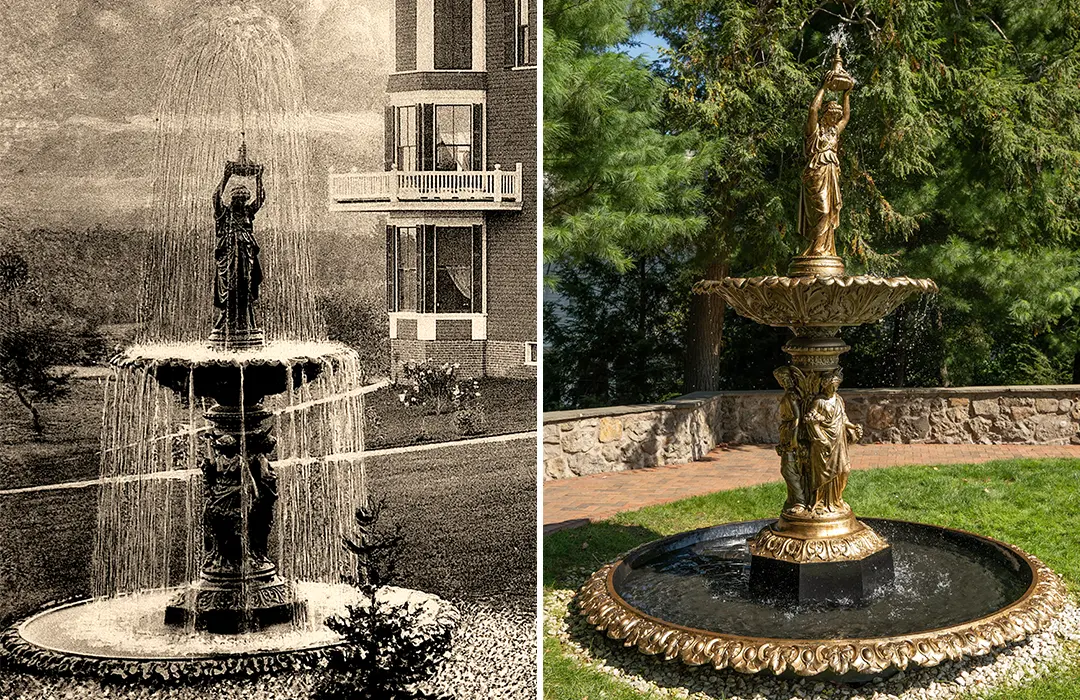
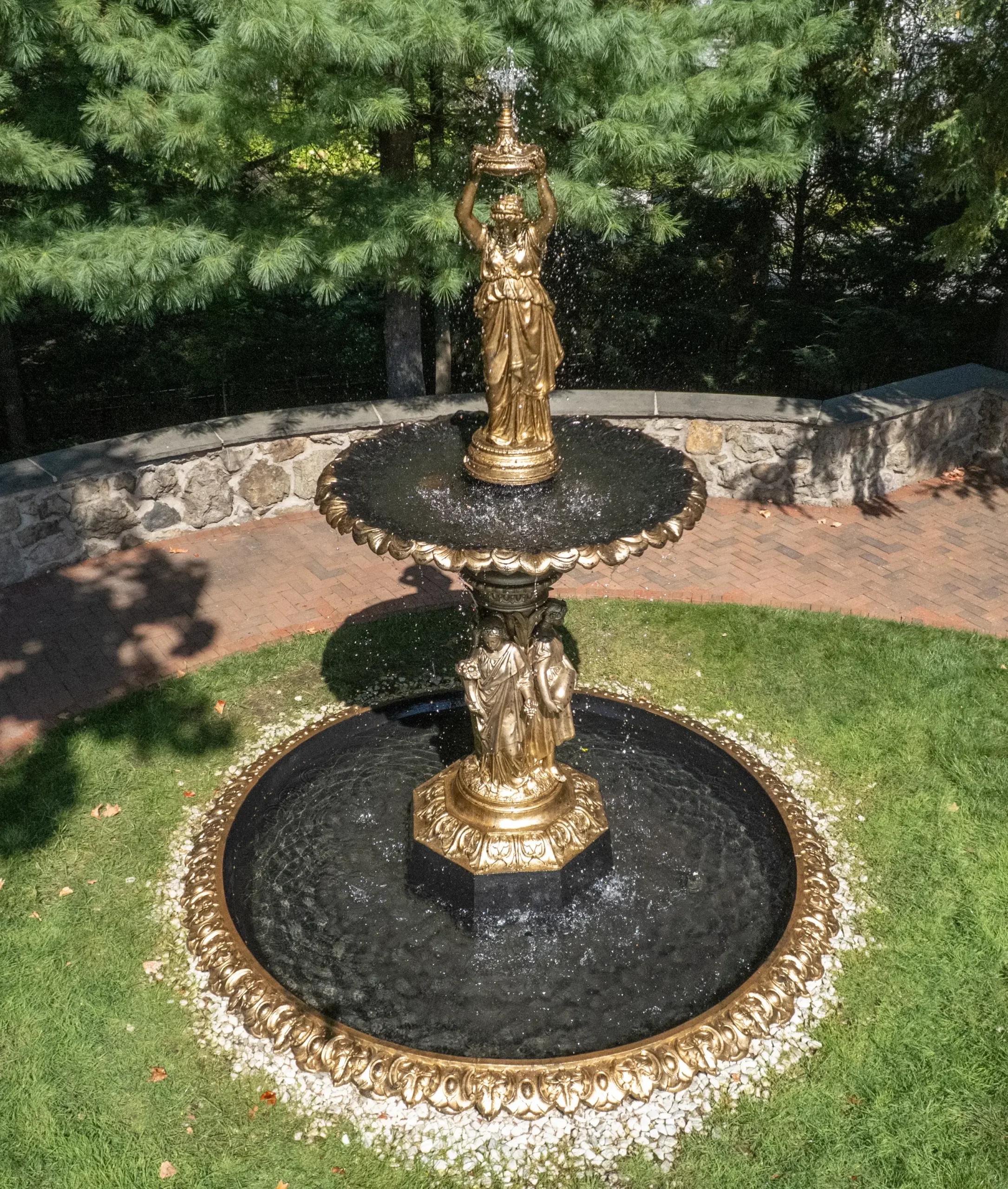
The fountain that helped inspire this timeless counsel from Mrs. Eddy and that once graced her front lawn at Pleasant View has now been under the stewardship of Longyear Museum for 50 years. A gift from the Christian Science Board of Directors in 1975, today it is a much-loved feature of the Museum’s Pleasant View Walk, continuing to delight visitors just as it did at Mrs. Eddy’s home.
An ornamental feature
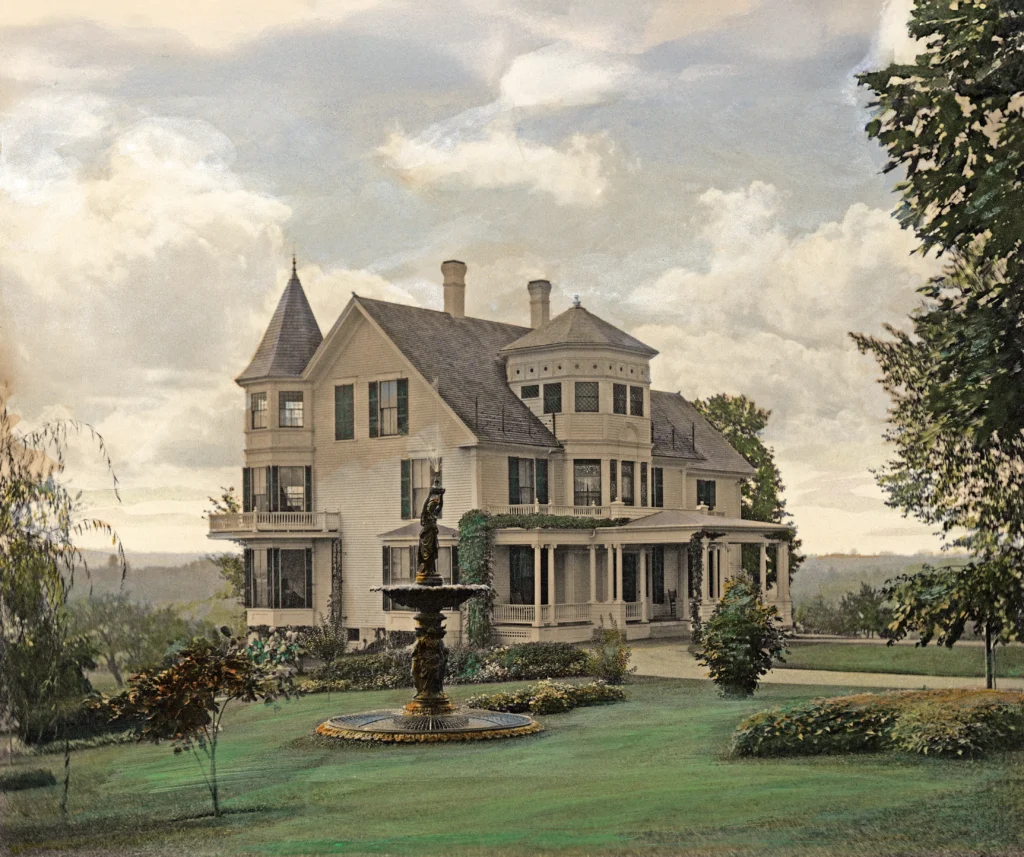
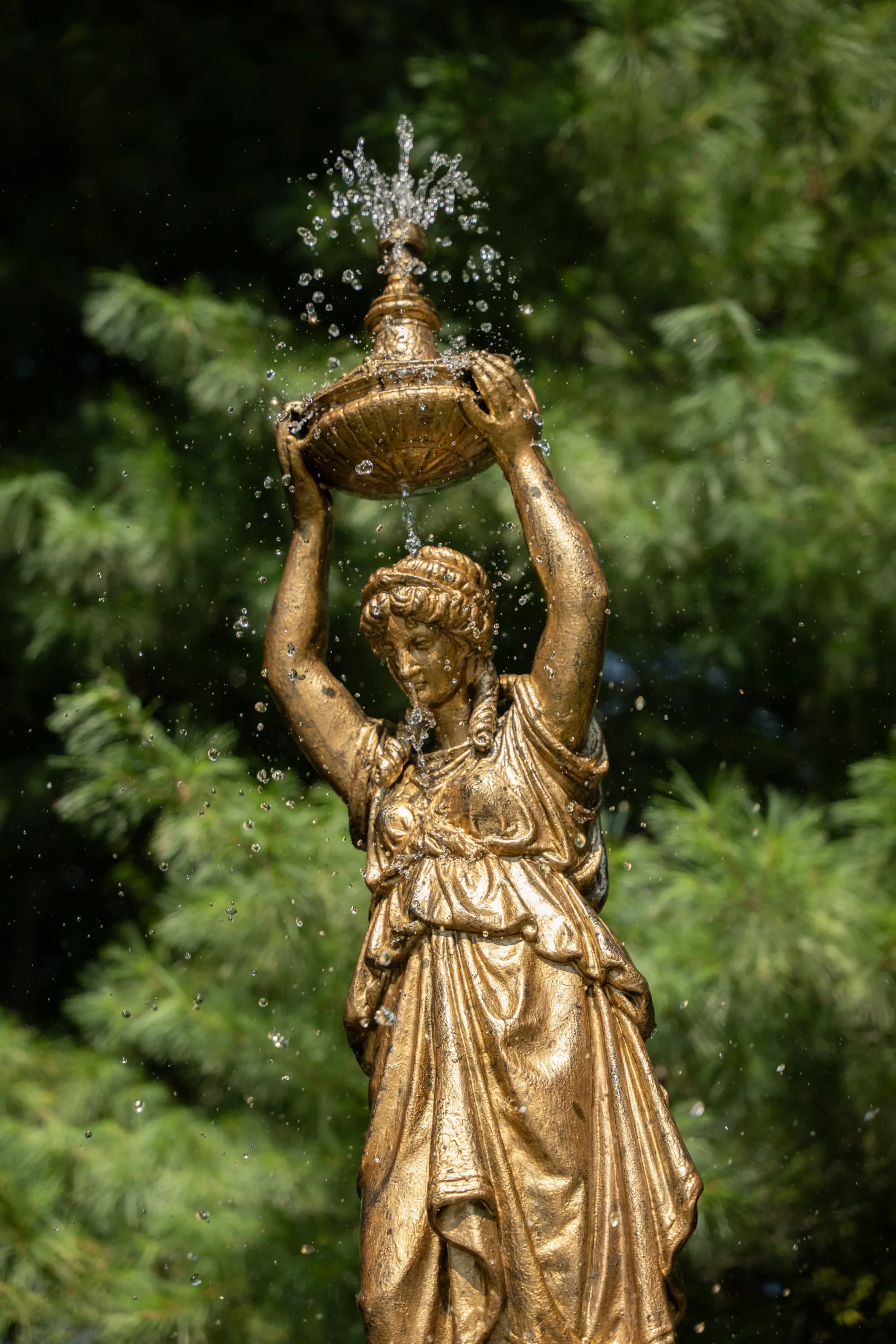
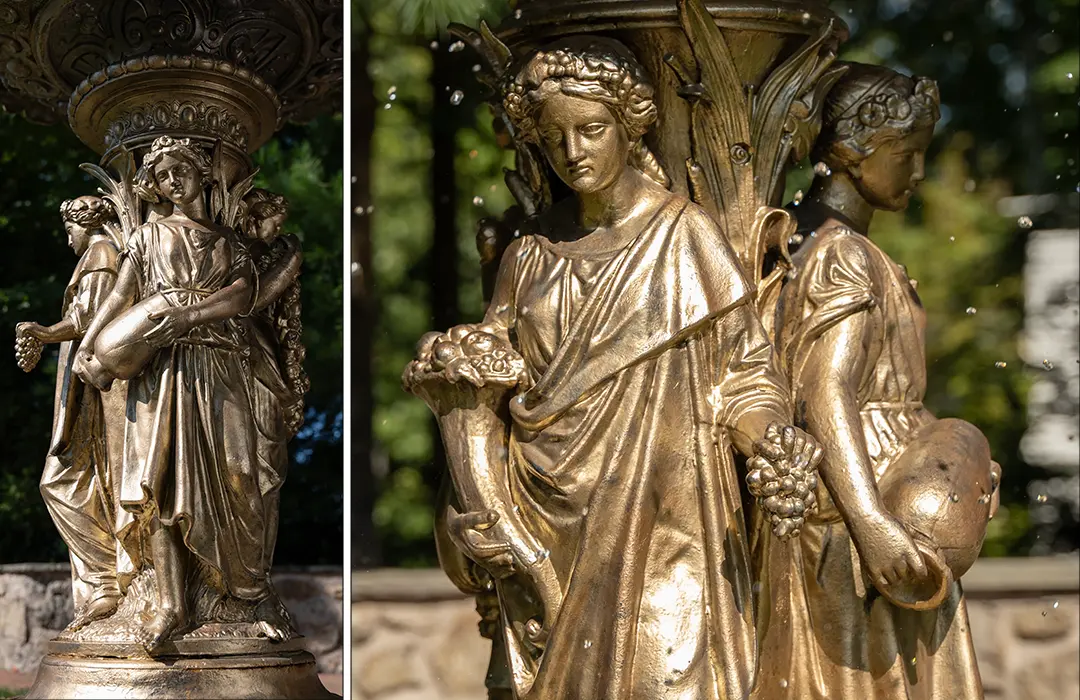
In 1892, the year she moved into Pleasant View, Mrs. Eddy chose for her front lawn a nearly 12-foot-tall cast iron and zinc fountain made by M.D. Jones & Co. of Boston, a leading manufacturer of ornamental iron works. With its two tiers of classically robed figures, it made a lovely focal point near the entrance to the property.
“[A] bronze fountain sends up its refreshing spray to the summer warmth,” noted one visiting journalist in 1899—referring to the bronze-colored finish of the fountain.3
Long before Mrs. Eddy had reached this point of leadership—and the financial wherewithal to purchase a fountain of her own—she had enjoyed spending time near fountains. In 1865 and ’66, while living in the home of the Newhalls in Swampscott, Massachusetts, and writing articles for local papers and speeches to give at a temperance society, she often sat on the granite wall of a fountain at the edge of their sloping lawn. “She would write a little while, then gaze into the water awhile as if waiting for inspiration,” George Newhall recalled.4
Years later, when Mrs. Eddy was hard at work as the main teacher and president of the Massachusetts Metaphysical College in Boston, she sometimes took a short walk to Chester Square, where she sat under a large elm tree and “watched the children playing about the fountain,” according to early worker William Lyman Johnson.5 The three-tiered fountain and nearby fish pond, as they were described in an 1873 guidebook, made for “a deliciously cool and pleasant spot in midsummer.”6
At Pleasant View, the basin of the fountain on Mrs. Eddy’s own lawn would be stocked with goldfish in the spring.7 She was fond of the little fish, and after her daily drives she often stopped by the fountain to feed them. Noting that thirsty dogs were snapping at them, she designed a copper wire cover with diamond-shaped holes that enabled the dogs to drink without reaching or harming the fish.8
Once, household worker Clara Shannon observed that when the fish appeared afraid of a reflection from Mrs. Eddy’s diamond ring, “she did not move her hand but called out to them, ‘Come, little fish, … you are not afraid,’ and they all returned and swam in and out between her fingers, regardless of the sparkling ring.”9
Mrs. Eddy’s fountain also served as a cool oasis when about 2,500 Christian Scientists came to hear her speak at Pleasant View on July 5, 1897. Young Will Cooper, visiting from Kansas City, Missouri, was among them. He had waited patiently for cold lemonade that someone was handing out. “One glass of lemonade did not satisfy me, but I was too bashful to ask for more,” he recalled. “I wandered up to the fountain … where someone had provided a tin cup or two and some of the guests were quenching their thirst there. I did the same.”10
No detail too small
At Pleasant View, as at all of her homes, Mrs. Eddy gave close attention to the details of her house and grounds. “Nothing was too unimportant to be done rightly, nor any error small enough to be overlooked,” observed her personal maid Adelaide Still.11
Regarding the fountain, Mrs. Eddy wrote to a gardener at one point, “It will not be as pretty to have any more shrubs on that side of the fountain. I see from my window it will hide the fountain from being seen on the street.”12
In the spring of 1893, something about the look of the fountain was unsatisfactory to Mrs. Eddy, and she corresponded directly with manufacturer M.D. Jones. The way the water was playing may have been an issue; he offered to send a jet “with fine holes if that would answer your purpose.”13
She was also evidently concerned about the finish turning from its original bronze color to white. Mr. Jones wrote that “a vase bronzed and varnished and rained upon will stand nicely while a fountain finished exactly [the] same would turn white.” It might have something to do with the water coming from the pipes, he theorized, adding some advice about how her painter could use a particular type of varnish.14
In another of the series of letters, Mr. Jones hoped to assure her of the quality of his work, telling her, “The fountain [at Pleasant View] is a nice one and its exact pattern is at Rumney, N.H. … In fact it was the first one made of that pattern.”15
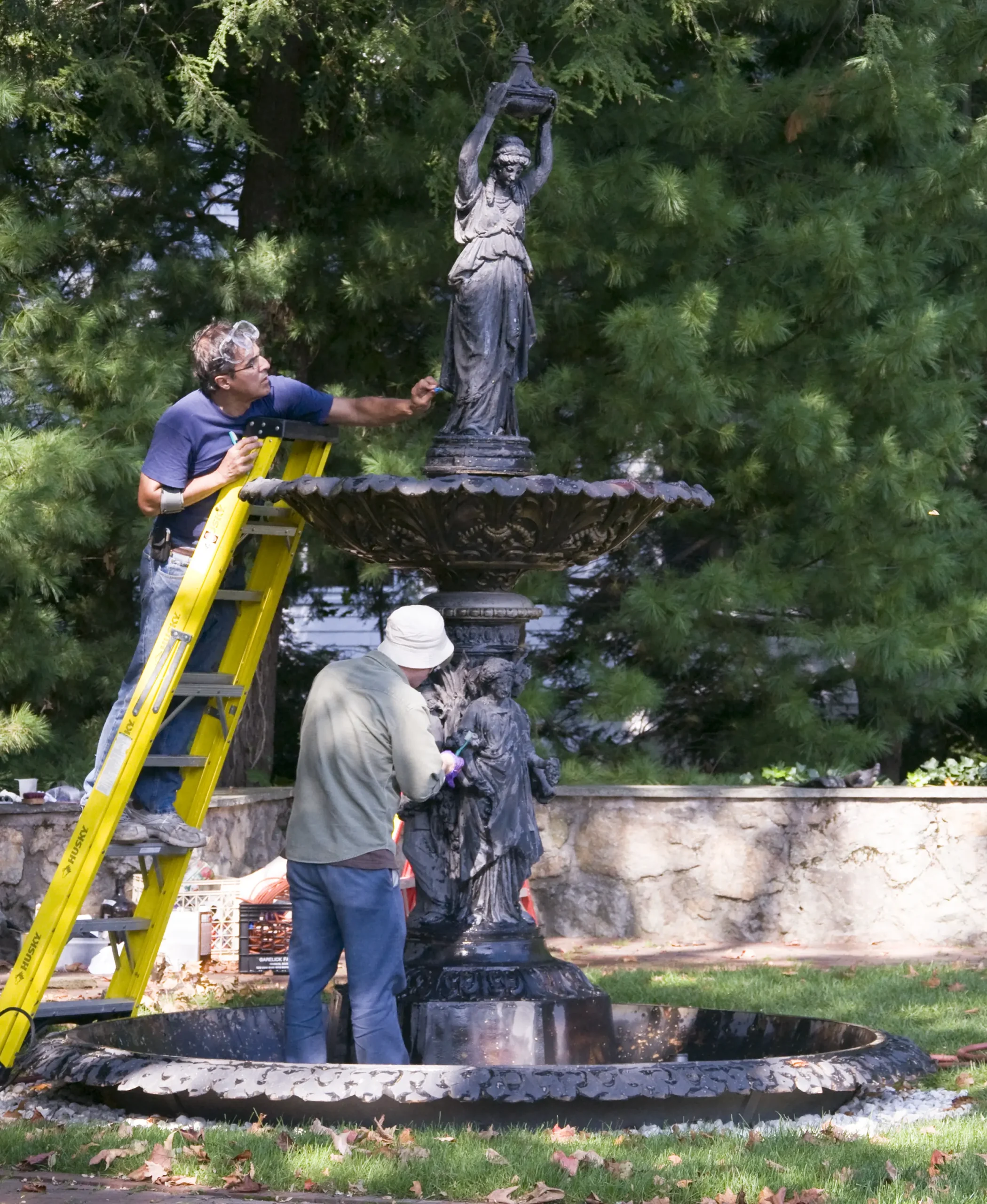
But as the problem continued, she persuaded Mr. Jones to send a man to bronze it. “A painter from M.D. Jones & Co. Boston commenced to paint the fountain today,” secretary Calvin Frye noted in his diary on April 23, 1894. Once the coating had thoroughly dried and it was time to turn the water back on, he noted simply on May 5, “started Fountain.”16
Five years later, in 1899, Calvin Frye enlisted the help of James Neal, a student of Mrs. Eddy’s and a Christian Science practitioner in Boston, to research how best to have the fountain refinished.
“There seem about as many theories on how to paint fountains as there are on the right road to Heaven,” Mr. Neal quipped. He conveyed experts’ instructions and suggested one who could come do the work for five dollars a day plus expenses. “There will be more or less trouble with the turning white until they have been painted two or three times,” the fountain makers told him.17
Continued conservation
It’s no surprise that a 19th-century fountain has continued to require special preservation and maintenance. But for each layer of paint applied and each adjustment to the water jets, there are precedents in the care taken by Mrs. Eddy and her staff. Just as they had to persist to ensure that the fountain displayed the beauty she expected, so Longyear’s Collections and Facilities teams have persisted in conserving it properly over the decades.
In 1975, following the decision of the Christian Science Board of Directors to give the fountain to Longyear, it was moved from New Hampshire to a central place in the azalea garden at the Longyear mansion in Brookline, Massachusetts, which housed the collection at that time. The fountain needed various repairs over the years.
In the late 1990s, when the Longyear Board of Trustees decided to build the current museum in Chestnut Hill, the time seemed right for a major restoration of the fountain. Grants and matching gifts from 28 states, Canada, and Switzerland, made it possible.
Experienced conservators from Daedalus, Inc., of Watertown, Massachusetts, stripped away the old paint and added a bronzing coat; they also rebuilt the water system within the fountain. They studied historic images to determine how the water should fall, “which was hard because in some [photos] it is spraying and in others it is cascading,” says former Director of Collections Cheryl Moneyhun.
The restored fountain was installed on the new museum grounds in 2001, along the Pleasant View Walk, which includes Mrs. Eddy’s original stone entry arch and one of her summerhouses (gazebos).
“It was heartening and very satisfying to see these things come into their own again and be put into a setting where people could enjoy them and see them as they had looked when Mrs. Eddy had them on her property,” Cheryl says.
Work has since been done periodically to keep the fountain properly coated and running well. To preserve it for generations to come, the fountain is covered in the winter, and the water is turned on periodically for visitors to enjoy during the warmer months.
An article in the North American in 1907 included this description of Pleasant View: “The air is filled with the perfume of the blossoms, and the birds are a great chorus of song to the peaceful symposium. A fountain is playing in the sunlight.”18 This may well be an apt description of Longyear’s Pleasant View Walk today.
Stacy A. Teicher is Longyear’s senior research associate.
Top photo: A hand-tinted photograph of Mrs. Eddy’s Pleasant View home in Concord, New Hampshire, with the fountain in the foreground. Longyear Museum Collection.
“Behind the Scenes”
Clues Lead to Pleasant View’s Sister Fountains
By Stacy A. Teicher
A student touring the Mary Baker Eddy Historic House in Concord, New Hampshire, peered into a diorama of her Pleasant View home, looked at the tiny fountain, and asked: Did the fountain have any special significance? Did Mrs. Eddy purchase it herself?
The questions stayed with me, and my research led to a feature in the Fall/Winter 2025 Longyear Review (the article above). It also uncovered some surprising historical connections with fountains in other communities in the Granite State—Rumney and Milford.
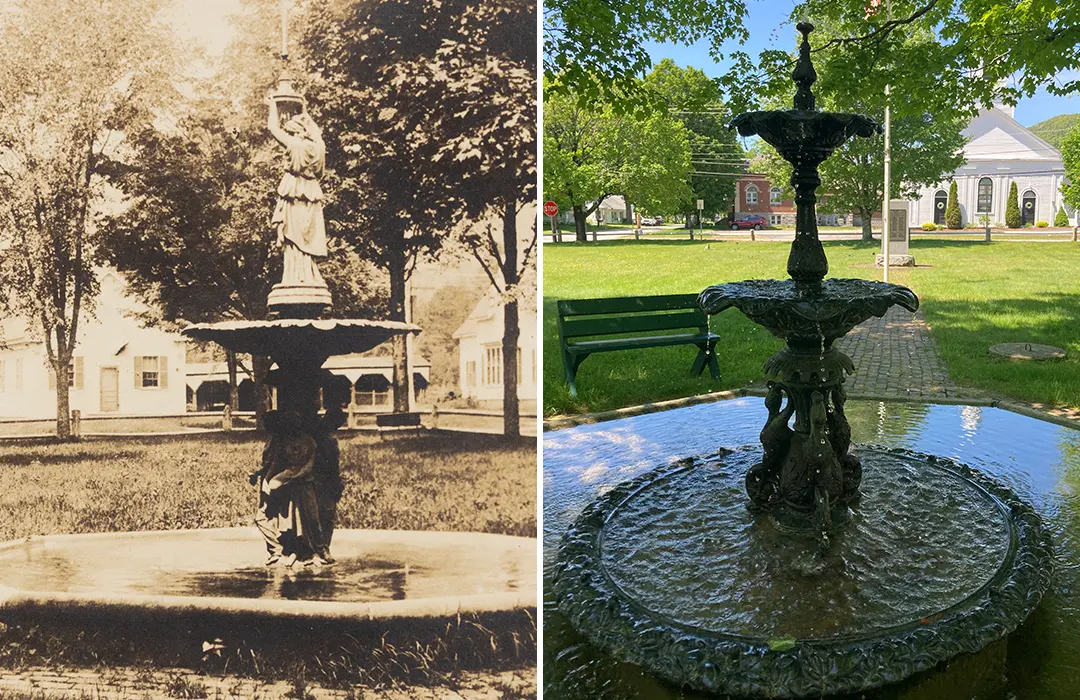
While researching the maker of the fountain, I also happened to be reviewing the tour script for Longyear’s historic house in Rumney. Reading a book on Rumney history one day, I did a double take after seeing a picture of a 19th-century fountain on the town common. It looked so familiar. When I compared it with pictures of the Pleasant View fountain, sure enough, at least the top figure was a match. The bottom tier in the Rumney image was too grainy to tell for sure.
Not long after, during a research trip to The Mary Baker Eddy Library, I found a treasure trove: correspondence between Mrs. Eddy and M.D. Jones of Boston, the maker of the Pleasant View fountain. As I went through the handwritten letters, I was delighted to find one in which he told her that the first fountain of the design she had selected had been erected in Rumney.19
A visit to the Rumney Historical Society unearthed a few more details. In 1876, the citizens of Rumney placed the public fountain on the town common after the wife of Josiah Quincy, a prominent lawyer and politician, led the fundraising efforts. One $50 donation came in from John Dearborn, the merchant who, in 1860, owned the home that Mrs. Eddy rented with her then-husband, Daniel Patterson.20
That fountain lasted nearly a century. By the mid-1960s, however, it had fallen into disrepair. Some citizens wanted to renovate it but found the prospect too expensive. The town dedicated a new, smaller fountain—placed on the original granite basin—in 1991.
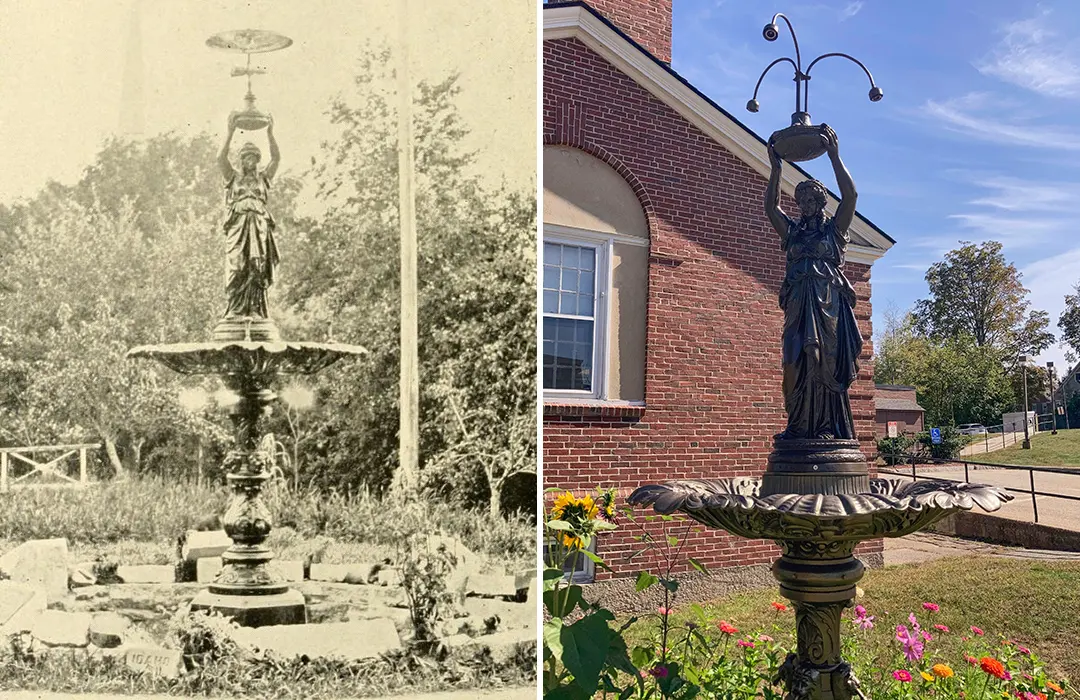
In another letter to Mrs. Eddy, Mr. Jones mentioned sending to Milford “a fountain which is to have electric lights” but otherwise very similar to hers.21
“Soldiers’ Memorial Light and Fountain” was dedicated in 1894 for Milford’s 100th anniversary. It has the same female figure on top, but she holds a light above her head, and the tier below is a simpler design, with lion-head spigots. A description of the Milford dedication ceremony noted that a little boy “turned the lever and eight jets sent high in the air their myriads of sun-tinted drops of pure, cold water.”22
Milford’s fountain was moved to its current position near the Wadleigh Memorial Library in 1950, and the town renovated it less than a decade ago. The light fixture on top has changed several times. The water no longer runs, but the sunlight glints off the bronze-colored finish during the day, and at night it is still lit up in red, white, and blue.23
A librarian who helped me learn about the fountain’s history was happy to see photos I showed her of the Pleasant View fountain, and to hear that Longyear has made the effort to preserve it and keep its water feature functioning.
I can’t help but think that in all those decades, I haven’t been the first to notice what I now like to think of as these “sister fountains.” Perhaps Mary Beecher Longyear, on one of her many visits to Rumney, stopped off at nearby Rumney Common to enjoy the fountain and realized it matched the one at Pleasant View, although I could find no such mention in her diaries. Historical knowledge is constantly evolving, and perhaps someday evidence will surface of others who appreciated the connection.