Picture a cavernous basement in a large 140-year-old New England mansion … rather dim and damp, comprised of numerous small rooms, nooks, and crannies sprawling over multiple levels and crisscrossed with pipes, wires, and conduits. You’d be wise to have a flashlight handy for negotiating dark corners, uneven floors, and low ceilings.
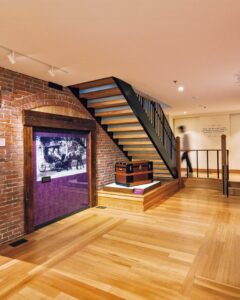
Now, in that very same space … envision a bright exhibit gallery, with gleaming wooden floors, richly hued walls, and a glass-encased entry vestibule! And imagine it filled with visitors, delving into the life and history of the home’s remarkable owner, the Discoverer, Founder, and Leader of Christian Science.
Over a period of several years, deep thought, prayer, and research have gone into transforming the basement of Mary Baker Eddy’s final residence in Chestnut Hill, Massachusetts, into a welcoming exhibit space that succinctly presents her life and mission to visitors. Join us on a tour of transformation and fruition as we introduce you to what, for the public, is the first stop on a journey into life at 400 Beacon Street.

Looking Beyond Limitations
As the second phase of major restoration of this historic property in Chestnut Hill, Massachusetts, got under way in 2018,1 Longyear Museum staff considered several key questions: Where and how should visitors be welcomed? And what should they see and learn when first entering the house?
The team wanted to preserve and interpret all the rooms that the household members used in the main house and to retain the spacious carriage house in its original form. Building a separate visitor center would be too complex and costly. So that left only one other option for receiving and briefing visitors before tours—that dark and damp basement!
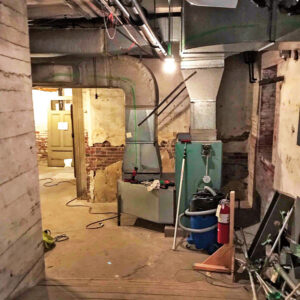
Initially, recalls Executive Director Sandy Houston, “All that we, as staff, saw was a dark rabbit warren of rooms at uneven levels, filled with antiquated equipment.” Fortunately, the team soon came to appreciate the brighter possibilities envisioned by Wolf Architects, the firm that had also worked with Longyear on restoring the first home Mrs. Eddy ever owned—her house in Lynn, Massachusetts. That shared experience of creating a modernized and code-compliant visitor space at Lynn (including an accessible vestibule-style entrance and a gallery/exhibit area) provided a helpful starting point for the undertaking at 400 Beacon Street.
Achieving the desired vision at the Chestnut Hill house called for extensive demolition, rebuilding, and reconfiguring of disparate sections of the basement. Previously, floors in different areas were at varying levels, joined by ramps and stairs. A single level was decided upon—determined by the need to run mechanical systems under the floorboards—and once built, it was surfaced with reclaimed lumber. Some walls were removed and doorways repositioned. Drainage issues were addressed, and new conduits and ductwork were laid. In addition, the space under the home’s large first-floor porch was enclosed with floor-to-ceiling windows to create a reception and store area. This sunlit, glassed-in area now welcomes visitors from the terraced rear of the house.
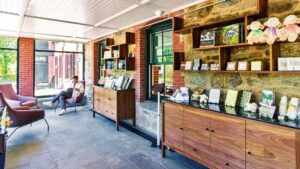
The messy work of construction proceeded concurrently with the exacting tasks of conceptualizing and designing the exhibit space and its components. Scott Rabiet, the owner and principal of Amaze Design, which has worked with the Museum to develop numerous exhibits, is grateful that Chris Milford—Longyear’s owner’s project manager who helped oversee the restoration at 400 Beacon Street—“had the foresight to early on ask us questions about mechanics and items we might need for exhibits to work.” This, he says, allowed Longyear and Amaze to “coordinate exhibit planning in parallel with the restoration process, so that all necessary lighting, power, data [cabling], and other resources were in place” from the get-go.
Envisioning the Exhibit
The end result today is that Longyear—within a 1,682-squarefoot space—has been able to concisely capture and vividly illustrate not only Mary Baker Eddy’s life and work, but also that of her household staff, the “family” who surrounded and supported her.
The exhibit content team consisted of Sandy, Director of Research and Publications Heather Vogel Frederick, and Director of Education and Historic Houses Pam Partridge. Partway through, they were joined by Senior Research Associate Stacy Teicher. Discussion and ideas multiplied, shifted, and coalesced, and soon had to be translated into choices and conclusions about content and production. While Sandy led the process, Stacy gradually took on the role of project manager, serving as a communication linchpin and coordinating with representatives from three firms—Amaze Design and Richard Lewis Media Group (RLMG), both based in the Boston area, and Explus, of Sterling, Virginia, which fabricated and installed the exhibit.
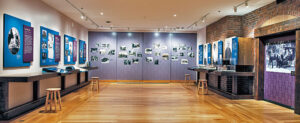
A guiding principle throughout the exhibit design process, Stacy says, was to “not just be thinking about what information or content we wanted to convey, but what experiences we wanted visitors to be having.” Exhibit components should serve as “conversation starters,” she explains, “prompting ideas, provoking discussion, thinking, and questions.”
Ultimately, the challenge was not so much in generating enough interesting content. Rather, it was how to winnow down a wide range of stories and introduce individuals, ideas, and incidents in sufficient detail—without inundating viewers with information.
Telling Mrs. Eddy’s Story
Realizing that many visitors might not be familiar with Mrs. Eddy’s history prior to her arrival at Chestnut Hill, the staff wanted to avoid giving only a partial impression of her life—one of apparent wealth and material comfort, hinted at by the large residence and expansive grounds.
“We wanted visitors to understand Mrs. Eddy’s journey,” Sandy says, from her childhood in rural New Hampshire to her discovery of Christian Science, writing of Science and Health with Key to the Scriptures, and the establishment of her church. The solution? Creating a clearly delineated seating space that hosts a large-scale timeline of key events in Mrs. Eddy’s life as well as a video monitor, where a short orientation film quickly brings visitors up to speed.
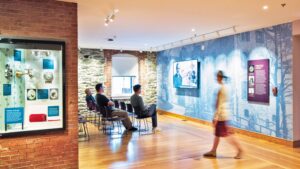
Longyear’s resident documentary producer, Web Lithgow, decided to draw on an extensive interview that the leading journalist of the day, Arthur Brisbane, conducted with Mrs. Eddy in 1907. (Mr. Brisbane was chief editor of the nationwide Hearst news organization, with a daily readership of nearly 20 million. He was, as Web puts it, “the Walter Cronkite of his time.”) Using Mr. Brisbane’s description of his conversation with Mrs. Eddy, Web says, “helps viewers understand her significance and stature as a national and international thinker and leader of renown.”
Combining Mr. Brisbane’s keen observations, a few of Mrs. Eddy’s own statements, and still images from a series of previously produced Longyear documentaries, the black-and-white video—created by Longyear Media Producer Ty Parmenter—succinctly recaps more than 80 years of an eventful life in under 15 minutes. It ends with Mrs. Eddy’s arrival at Chestnut Hill on the snowy evening of January 26, 1908—and leaves the rest of her story to be told by the exhibit and guided tours of the restored house.
Getting Things Just Right
While conceptualizing the exhibit space, the Longyear team paid heed to a key observation shared by Chris Milford. “As a visitor,” Chris remarked, “I’d want to know … ‘What is this Christian Science?’”
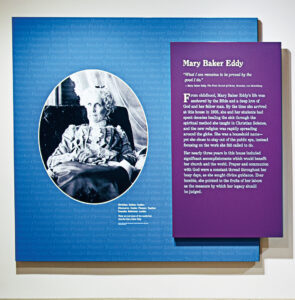
A simple, sincere question, but a tall order! How to describe in so limited a space so vast a subject? Although the panel about Christian Science is the first of an opening series in the main exhibit (positioned right by the introductory video screen, photo immediately above), it was the last one to be completed, taking “a lot of work, a lot of thought and prayer, editing and re-editing … to distill the content,” Heather Frederick says. The aim was “absolute clarity” and for it to be “commonsensical and not abstract.”
The team elected to highlight Mrs. Eddy’s deep love and study of the Bible and set out the essence of Christian Science in two citations from her writings referring to its name and nature: Christian, “because it is compassionate, helpful, and spiritual,” and Science, as it offers “proof, by present demonstration” of an “ever-operative divine Principle.”2 The panel also includes a photograph of The Mother Church, The First Church of Christ, Scientist, in Boston, and explains that the Bible and Science and Health together serve as the Pastor of Christian Science churches.
Subsequent panels, juxtaposed with interactive displays and objects, introduce Mrs. Eddy’s God-centered life and work and summarize key events relating to her time at 400 Beacon Street. They touch on the founding of The Christian Science Monitor and detail other work of the Chestnut Hill years—including revisions to her major writings. In a section outlining how Mrs. Eddy’s “Mission Carries Forward,” visitors can peruse a sturdy binder of selected testimonies of healing from the Christian Science periodicals, the Tenets of Christian Science, and copies of the Bible and Mrs. Eddy’s writings (Science and Health, Prose Works, the Manual of The Mother Church, and Poems).
“There are not that many words on the exhibit walls,” Sandy comments. “But we went over and over those that are there, to be sure that they had the right tone and could be understood by someone not familiar with Christian Science, … and also that they might inspire a longtime Christian Scientist.”
Such attention to detail was appreciated by the Amaze team, which has designed exhibits for the American Writers Museum in Chicago, National Museum of Australia in Canberra, and Birmingham Civil Rights Institute, among others. Describing Longyear as both a “gracious and demanding” client, Scott notes how the Museum “pays an extraordinary level of thought and attention to every detail. Getting things just right is the main priority for them.”
Enhancing the Visitor Experience
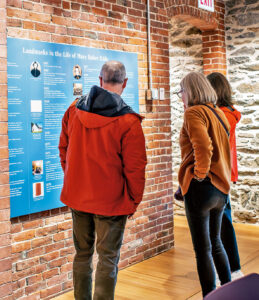
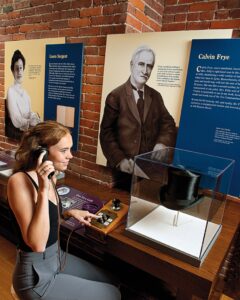
Communicating and conveying accurate information in an appealing, engaging, and digestible form was a priority for Longyear. With the help of Amaze and RLMG, various hands-on elements throughout the exhibit invite visitors to interact with the content. These include high-tech touch screens as well as good old-fashioned newsprint. A full-size facsimile of the first edition of The Christian Science Monitor is available for visitors to leaf through. And clever use of an old-style intercom telephone (similar to those in several rooms in the house, and pictured at the bottom of this page) allows listeners to hear recorded vignettes in the words of several household staff.
The team was also deliberate and creative in finding ways to incorporate child-friendly information and experiences. (See the companion article, “Please Do Touch.”)
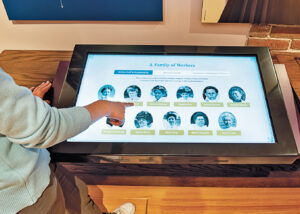
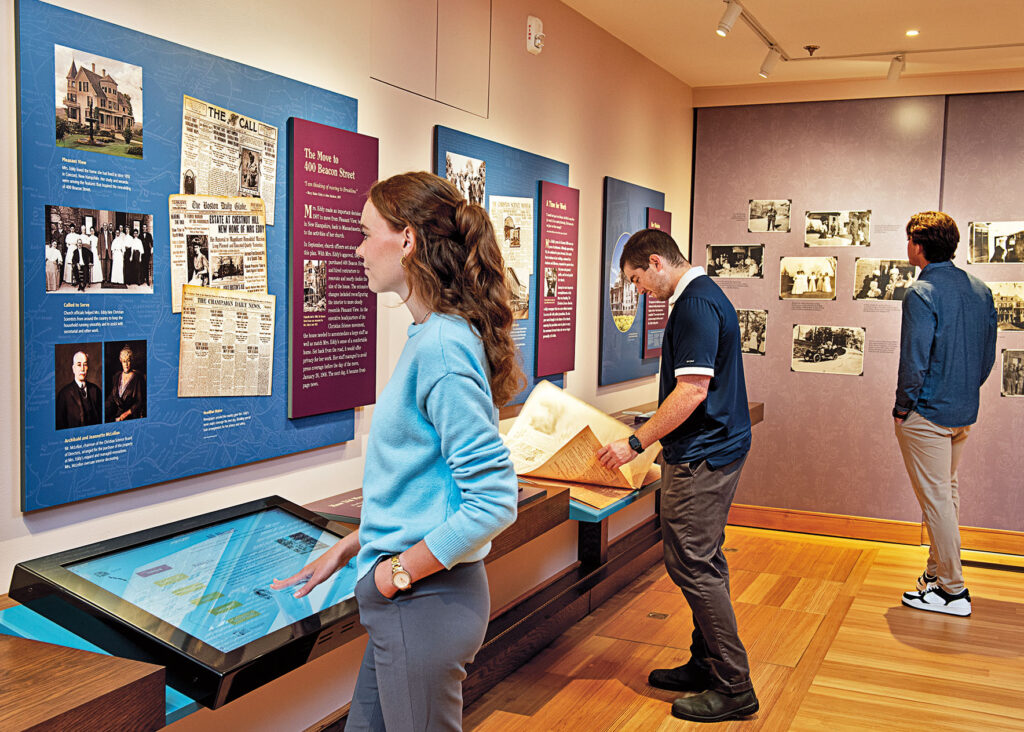
Another interpretive choice was to communicate information in the “voice” of Mrs. Eddy’s aides and staff. Excerpts from their reminiscences help to tell the six-part story of Mrs. Eddy’s move from New Hampshire to Chestnut Hill in the interactive display called “All Aboard!” And quotes and photographs from staff albums are utilized to good effect in the section titled “A Family of Workers” (photo above). Here, touch-screen technology and profiles based on detailed research help visitors get to know 21 resident household members—seven secretaries and metaphysical workers, 11 housekeeping and kitchen staff, and three maintenance and grounds workers.
Learning from the Household Workers
For seasoned Christian Scientists, Longyear wanted to present fresh material and worked to identify previously unpublished or undisplayed images and artifacts from the collection. The exhibit highlights precious individual memories and mementos that help tell the stories of three household members in personal and touching ways—for example, an illustrated poem given as a gift by Mrs. Eddy (Minnie Scott); a Science and Health with handwritten notations (Laura Sargent); and a stately, beaver-fur top hat (Calvin Frye).
The Longyear team, Heather explains, thought and prayed about how best to choose and present what she calls “gems” of information and inspiration for visitors. The process—and the result—have spawned fresh appreciation for the commitment and unselfishness with which Mrs. Eddy and her staff fulfilled their roles and forwarded her mission.
As Stacy describes it, “mining the reminiscences of household workers” provided new views of the “spiritual foresight and authority Mrs. Eddy was demonstrating, and the depth of her practical Christianity.” This in turn, she says, “raised the bar for me for my own practice, for what I should be learning spiritually and demonstrating.”
And, as a recent visitor to Chestnut Hill and Longyear’s other Mary Baker Eddy Historic Houses puts it, the experience has “brought me closer to our Leader, and I’m so grateful her history is being preserved in this way.”
With the exhibit providing a foretaste of the rich and multilayered story of Mrs. Eddy and her time at this home, Longyear’s hope is that visitors will be even more curious and interested in what is to be further gleaned during guided tours of the home’s living spaces, including workers’ rooms and Mrs. Eddy’s own suite.3
This article was originally published in the Fall/Winter 2024 Longyear Review. Armin Sethna was a senior writer/editor at Longyear Museum.