In May 2024, Longyear Museum successfully completed a thorough restoration of 400 Beacon Street, the final residence of Mary Baker Eddy, the Discoverer, Founder, and Leader of Christian Science. In this online series, we reprise “‘The Dearest Spot on Earth’” from the 2024 issues of the Longyear Review, taking readers on a tour through the interior of the immaculately restored house in Chestnut Hill, Massachusetts. Rooms from Part 1 of the series were placed online between October 2024 and January 2025. Starting in June 2025, we began regularly adding new rooms from Part 2 of the series to the “itinerary.”
What happened in this room?
Seamstress Nellie Eveleth’s snug, light-drenched third-floor quarters were deemed as having the best view in the house by Mary Baker Eddy, who relocated here temporarily while her own suite was being remodeled in the winter of 1908. A clergyman’s daughter from Maine, Miss Eveleth was healed through Christian Science after being given just a few days to live. She started working for Mrs. Eddy at Pleasant View, where she improvised a sewing spot in the room of Adelaide Still, Mrs. Eddy’s personal maid. Here, she was provided a comfortable suite—a cozy bedroom connected to a dedicated workspace “equipped with all the machinery of her trade,” according to William Rathvon.1 Miss Eveleth, who would go into the public practice of Christian Science, used “her Science continually” in her work making and mending clothes for Mrs. Eddy.2
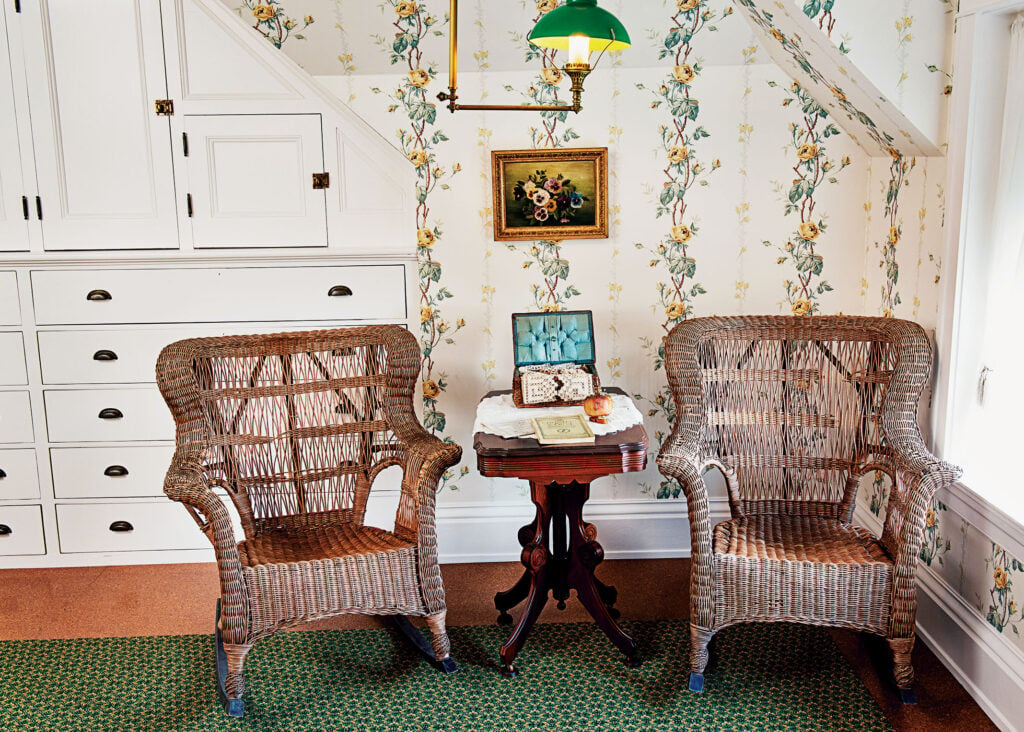
Gathering spot: After hours, Miss Eveleth’s workroom doubled as a sort of “club room” for some of her fellow household members, according to Mr. Rathvon, and indeed, historic photos show several comfortable chairs that would have accommodated them as they visited and read aloud together.3 A “No Tattling” sign that Miss Eveleth hung on the wall was a nod to a memo that Mrs. Eddy circulated to her staff in December 1908, reminding them not to gossip or tell on each other.
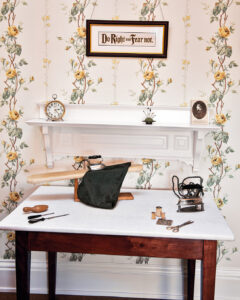
Everything’s coming up roses: As in several other rooms in the house, the wallpaper in Miss Eveleth’s suite was long gone by the time Longyear arrived on the scene. And once again, clues were found that provided the answers as to pattern and color. In the workroom, the twining yellow roses were discovered behind the decorative mantel; in the adjoining bedroom, clusters of soft pink roses were hidden behind the door trim—a section of which can be lifted as a “window on the past,” where visitors can see the original wallpaper.
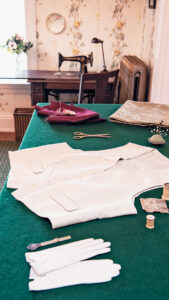
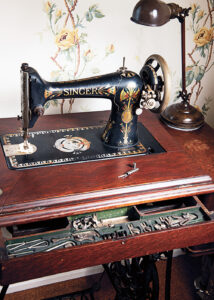
Photo at top of page: Miss Eveleth’s spacious workroom offered both electric and natural light, ample storage for fabric, notions, and supplies in a floor-to-ceiling wall of drawers and cupboards, and a designated spot for both a worktable and a sewing machine.
Each “stop” in these freshly interpreted period rooms touches on fascinating details about historic restoration. And it also offers a window into the daily routines of “family” life and the prayer and practical accomplishments that took place during the three years that Mrs. Eddy and her staff lived and worked at 400 Beacon Street (1908–1910).
The Dearest Spot on Earth”: Part 1
Introduction
The Library (October 2024)
The Dining Room (November 2024)
Mrs. Eddy’s Study (December 2024)
The Pink Room (January 2025)
Calvin Frye’s Office (February 2025)
“The Dearest Spot on Earth”: Part 2
Introduction
The Kitchen (June 2025)
The West Room (July 2025)
Laura Sargent’s Room (August 2025)
The Sewing Room (this page)