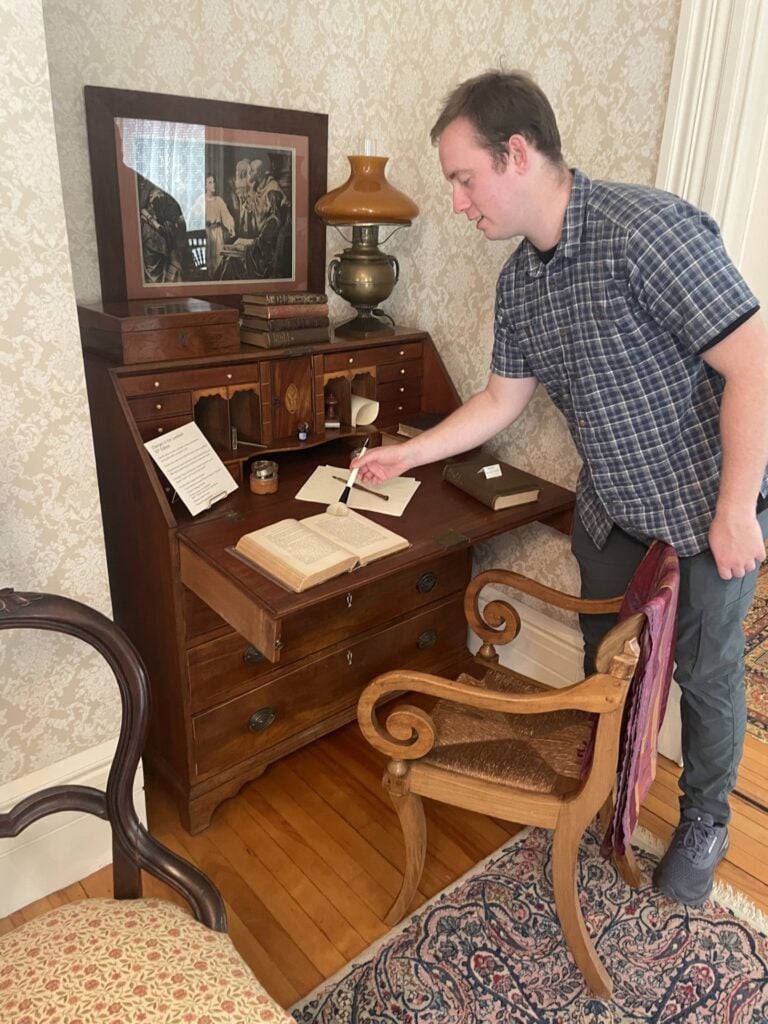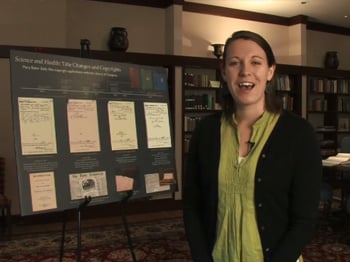
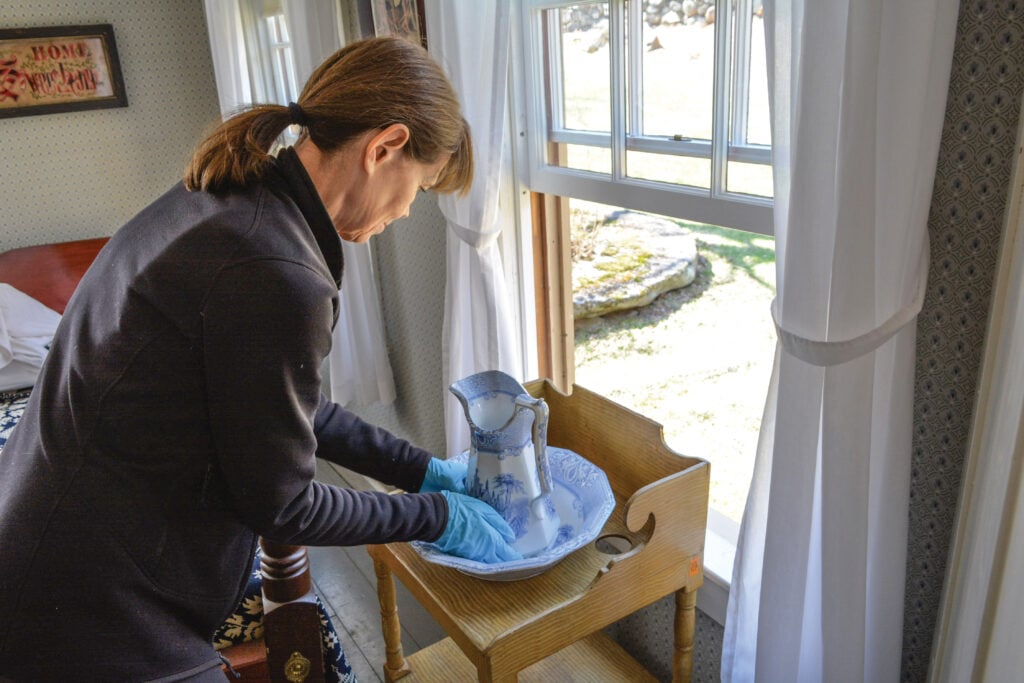
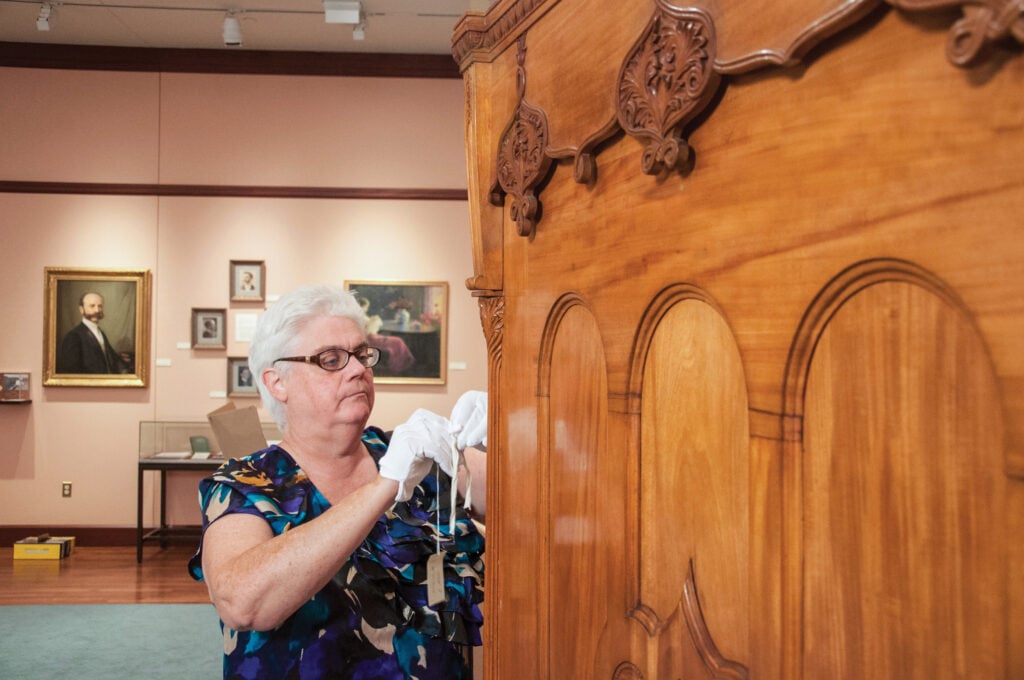
It’s inventory day at the Mary Baker Eddy Historic Houses in Rumney and North Groton, New Hampshire. Sarah Sampson, senior manager of collections, and Heather Herrington, a collections associate, are checking off furniture, artwork, and other items on a list printed out from the Museum’s collections database. Their goal? To make sure that everything in each house is on the list and in the database—and vice versa, that everything listed as on display in the house is actually there. It’s a best practice in the museum world to do an inventory like this on a regular basis, and each time the staff reviews the house contents, they take the opportunity to flesh out information in the database.
In the Rumney parlor, Heather opens a cabinet behind the door and pulls out a set of glass bowls. Like most items in the house, they are props—period pieces used to help tell Mrs. Eddy’s story, since only a few of her own belongings from that era remain. The bowls have been on inventories for the house since 1925, but to improve the records, Heather places them one by one on a white cloth and photographs them with her cell phone. Meanwhile, Sarah carefully picks up a small Bible, and pencils in an object ID number to match what’s on her list. Later, they move on to North Groton, where preparations for opening the house to visitors for the season include setting up a new foam mattress on one of the beds, getting down on the floor to tuck in the sheets and, finally, adding a historically accurate bedspread.
It’s a full, fast-paced day of tending to parts of a collection that encompasses eight historic houses spread across two states, along with tens of thousands of items at the Museum in Chestnut Hill, Massachusetts.
To spend time with this skilled team of professionals is to begin to understand the collection that is at the beating heart of Longyear and its mission to advance the understanding of the life and work of Mary Baker Eddy.
“The collection is what makes Longyear a museum,” says Executive Director Sandy Houston. “It provides a focus for our work. It’s the basis of our exhibits, our educational programs, our tours, and our publications. There are aspects of the collection that are unique to Longyear. For example, no other organization owns, cares for, and gives public tours of historic houses that Mary Baker Eddy lived in. The collection of letters, books, and other artifacts that belonged to the Baker family is also completely unique to Longyear, as is our collection of nearly 200 portraits of pioneer Christian Scientists.”
From Modest Beginnings
The Museum’s collection began just over a century ago when Mary Beecher Longyear started gathering artifacts, reminiscences, and other documents related to the life and work of Mary Baker Eddy, as well as to the early pioneers who stood with her in establishing the Christian Science movement. (See “It Started With a Spinning Wheel.”) Mrs. Longyear knew that these objects would provide durable evidence of Mrs. Eddy’s history, but she also saw the need to do more than that: to ensure that the story of the Discoverer of Christian Science is “guarded for posterity.”1
“I am trying to forestall all rumors and misconceptions that might arise in the future, detrimental to her character and circumstances,” she wrote in 1926.2
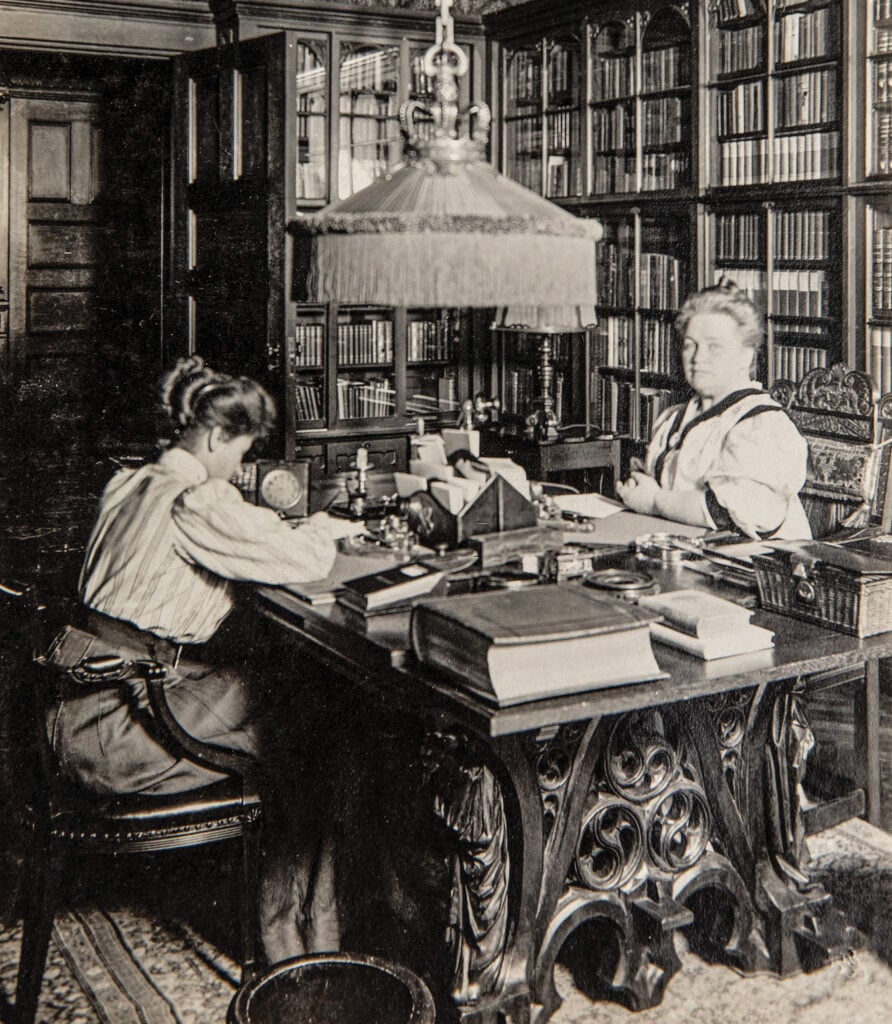
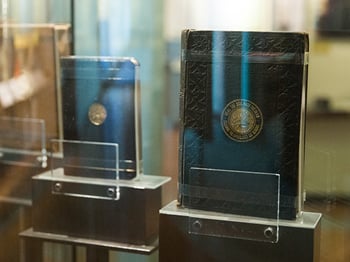
Today, the collection ranges from one of the smallest artifacts Longyear owns—a half-inch cross-and-crown lapel pin—to what is indisputably the largest: 400 Beacon Street, Mrs. Eddy’s 18,000-square-foot final home in Chestnut Hill. It encompasses artwork and jewelry (see “Gifts From the Heart”). There are historical documents and books, including inscribed copies of Mrs. Eddy’s writings and more than 400 early editions of the Christian Science textbook, Science and Health with Key to the Scriptures. The collection also includes handwritten letters from Mrs. Eddy, as well as furnishings, decorative items, and carriages that belonged to her. Hundreds of photographs and portraits of early workers, along with their correspondence and scrapbooks, record their lives and contributions to the movement. Among the crown jewels of the collection are the rare Baker family materials—dozens of handwritten letters, furniture and household items, and even schoolbooks used by the Baker children. Additionally, there are objects that have no direct connection to the early history of Christian Science other than the fact that they date from that period. These “props” are often used to depict Mrs. Eddy’s life in a particular historic house when few original furnishings survive.
In total, there are more than 65,000 items in the collection, and all come under the diligent care of Longyear’s Collections Department, which seeks to ensure they are protected in the right environment, cleaned and conserved properly, tracked and recorded according to best practices in the museum field, and available to researchers. Their job is to ensure that the collection will be available to provide reliable documentation of Mrs. Eddy’s life and work and help tell her story for generations to come. (See “The Longyear Collection by the Numbers.”)
A Team of Professionals
On Feb. 8, 1924, Mary Beecher Longyear noted in her diary, “Miss Smith is working constantly on our great collection of Historical Data regarding the Christian Science movement and Mrs. Eddy.”3
At that time, Marguerite Smith was the only employee working alongside Mrs. Longyear to collect and record artifacts. As the collection grew over the decades, however, so did Longyear’s staff. Today, the museum employs roughly three dozen staff members, including five in the Collections Department—three full-time and two part-time. Like Miss Smith before them, the Collections staff is “working constantly” behind the scenes—drawing on decades of professional experience and wide-ranging expertise, using contemporary tools, but with a similar deep affection for this “great collection.”
As senior manager of collections, Sarah Sampson provides leadership, coordination, and guidance for the team, and also interfaces with the public to respond to queries about donations, permissions, and research. A veteran of more than 13 years on the staff—some in an earlier part of her career, at a critical time when Longyear was packing its collection and moving into a new, purpose-built museum in 1999—Sarah has experience in virtually every facet of the Museum’s work, from giving tours and working with young people, to building databases and making careful records about artifacts, to caring for historic houses and their contents.
But talk to her for a few minutes, and what most comes through is her deep knowledge of Mary Baker Eddy, as well as the operations of her household—which often provides inspiration for the work of the Collections team.
“Order is really the key thing I value,” Sarah says. “Mrs. Eddy had her house ordered down to the pincushion, so she didn’t even have to look and she could pick the pin out that she needed.4 That was just a reflection of ordered thought. Certainly her house at 400 Beacon Street was very ordered and tidy and efficient. Those are qualities that I think are really helpful for Collections—to be ordered, efficient, tidy, and accurate.”
A 21st-Century Tool to Promote Order
Sarah and her team have a state-of-the art professional tool to help them keep the artifacts Longyear holds in its exhibits, vaults, library, and historic houses in proper order: an industry-standard museum database called PastPerfect. “It’s something we all work in every day,” she says.
One hundred years ago in Mrs. Longyear’s day, acquisition dates, previous ownership, and other information about items in the collection were recorded by hand in leather-bound accession books. Over time, these were replaced by typewritten binders, carbon-copy receipt books, and eventually individual index cards. By the 1990s, with the move to the new building, Longyear entered the computer age with a basic database that Sarah helped to build. The Collections team still refers to the earliest records regularly, and, Sarah points out, all methods of tracking the collection were considered best practices of the time.
Adopted in 2007, PastPerfect represented a huge step forward in maintaining order in the collection. Its records hold a wealth of information that can be accessed quickly—for example, the period from which an object or document dates, its measurements, location, author or creator, provenance (record of ownership, sometimes back to Mrs. Eddy’s day, to help verify an object’s authenticity), and other related historical information the staff has uncovered over the years. Files can be attached to the records as well, including photographs, articles, and films in which the item was mentioned. “You can sort and organize and create reports and find things really quickly,” Sarah says. “It’s a crucial tool.”
Recording information on thousands of artifacts into PastPerfect has been a massive (and ongoing) project that all team members participate in. With artifacts being regularly accessioned into the collection, new records are created all the time—for example, entries for each of the 125 letters recently donated by relatives of Laura and Victoria Sargent, sisters who worked side by side with Mrs. Eddy. Updating data is also part of the ongoing work: Several staff members recently finished adding specific location information in the vault (box number, file number) for 900 items—from letters to calling cards—that had belonged to early workers Joseph and Mary Armstrong.
Professionals on the Job
Keeping the collection in order—through hundreds of patient, detail-focused hours—is just one facet of the team’s duties. Another skill they have in spades is sleuthing. Whether they’re tracking down information for researchers, examining undated photographs to try to pin down a timeline based on clothing worn by the subjects, deciphering 19th-century handwriting, searching for just the right artifact to add to a new exhibit, or ferreting out the provenance of a prospective donation, they’re on the job.
“If you like a mystery, that’s sometimes museum work,” says Collections Manager Leslie Vollnogle. Having worked at Longyear for 14 years, and with advanced degrees in both library science and public history, along with broad general museum experience, Leslie is often the go-to person for help in finding something that doesn’t come up readily during a computer search—so much so that the team sometimes refers to her as “Siri.” A specialist in genealogical research, Leslie was the one who sorted out the family tree of the Sargent sisters (who happened to be married to two brothers) when their letters came to the Museum. Her wide knowledge of American history and museum best practices (want to figure out how to organize a collection of photos? ask Leslie!) bolsters all the operations of the department.
Registrar Karl Taglier brings long experience with historical institutional records to his work—an asset in his role overseeing the Museum’s accessions. With a wide knowledge of publishing, he manages the collections of Mrs. Eddy’s writings. But he is also often called on for sleuthing duty—thanks to his deep knowledge of Christian Science history. “Karl is an encyclopedia. He does not forget a thing,” Sarah says. “We’ll pull out a postcard of The Mother Church, and he’ll say what date it was based on whether the park was out front or the reflecting pool, or how the building was renovated.”
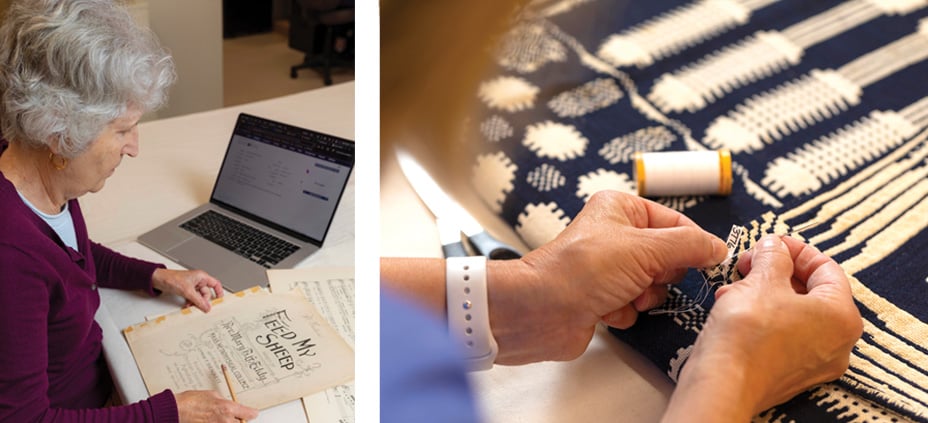
Other expertise is tapped for the work, as well. Collections Associate Debbie Slade Pierce spent her career teaching music and math at a private school and singing with chorales like the Boston Symphony’s Tanglewood Festival Chorus. After retirement, she began working part-time for Longyear. In 2020, Debbie worked closely with a conservator who restored an 1840s reed organ in the Mary Baker Eddy Historic House in Amesbury, Massachusetts. She also helped evaluate how best to move the two historical pianos in Mrs. Eddy’s final home, aided with the research on a chapter on music in the Longyear Press publication Life at 400 Beacon Street: Working in Mary Baker Eddy’s Household, and is currently cataloging the Museum’s sheet music collection.
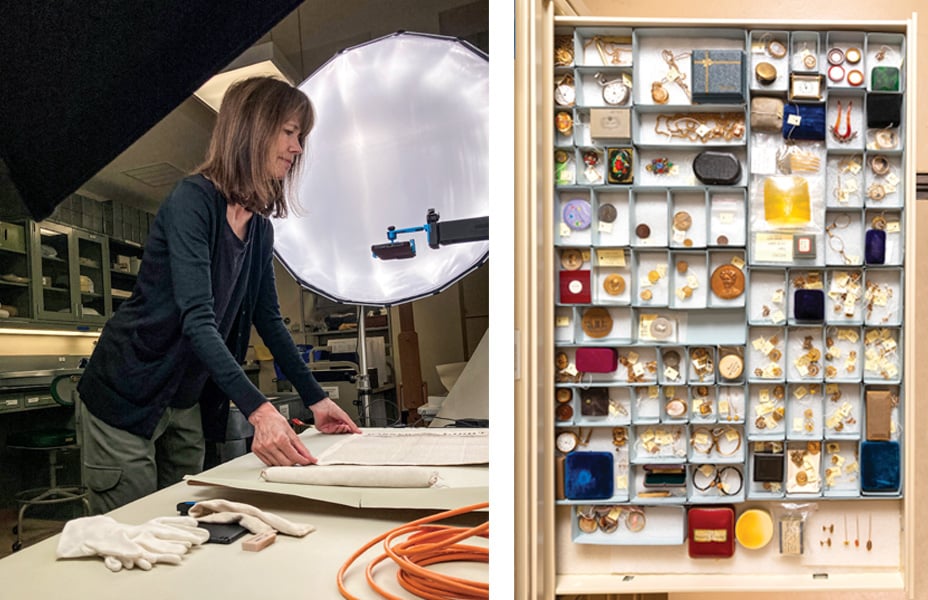
Heather Herrington, also a collections associate, brings a love of detail and organization, as well as a single-minded focus, to her work. Her eye on the collection is often through the lens of a camera. Aided by studio lights, a huge white paper background, and a device that holds her camera steady above objects, Heather takes thousands of photographs that are attached to records in the PastPerfect database. Recent donations and older acquisitions without images are under her purview. Earlier this year, for example, after a gift of 321 items, she powered through 1,576 photographs—recording everything from inscriptions in books to conditions of documents. Heather subsequently edited and organized the pictures, using standardized naming conventions for ease of finding. Her organizational skills come in handy for other projects too, whether she’s keeping the department well stocked with supplies—acid-free tissue, silver polish, Mylar, and the like—or matching myriad keys at 400 Beacon Street with the pieces of furniture they are meant to unlock.
At the end of the day, beyond the expertise and experience that staff members bring to their work, there is one key aspect that sets them apart from their colleagues in the general museum field: They strive to practice the teachings of Christian Science in their work.
Sarah explains that when the team spends a day cleaning artifacts at 400 Beacon Street, for example, they often consider the humble mindset of the Christian Science practitioners and teachers who did household work for Mrs. Eddy. “It’s been a really special reminder to me,” she says, quoting Science and Health, “to ‘stand porter at the door of thought’ and be careful what I’m bringing into this household.”
A Service Department
Working in any museum necessarily involves interactions between departments. It’s a two-way street of helping and being helped, and this certainly proves true for Longyear’s Collections team.
“We are a service department,” Sarah says, both internally and for those from outside the Museum. Art and other objects in the collection are sometimes the inspiration for marketing materials and new store products, for instance, and need to be gathered and evaluated. The media, research, and communications teams also turn to Collections for help finding photographs, correspondence, and other material related to the subjects of articles or videos.
“Those of us who are writing research articles for Longyear couldn’t do our jobs without the assistance of the Collections team,” says Director of Communications Alice Hummer. “For example, when I was working on the children’s article in this issue, about Mrs. Eddy’s time at the home of the Wentworth family in Stoughton, Massachusetts, Sarah and her staff brought me all kinds of documents from the vault to read and mine for details. I had quick and easy access to Lucy Wentworth Holmes’ handwritten memories of her childhood, family records, and even correspondence between Lucy and Mary Beecher Longyear, among other treasures. Their help was invaluable.”
Collections also fields requests for visits to the Daycroft Library (the Museum’s visitor library that contains everything from reminiscences of early workers to volumes on American and religious history), and for permission to use historic photographs, which often come from independent researchers and those preparing talks or publications for Christian Science groups. And they coordinate semiannual deep cleanings at the Mary Baker Eddy Historic Houses, working closely with the staff who manage those sites.
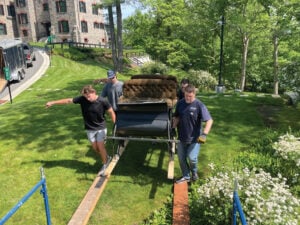
Helping hands come from the other direction, too. The Museum’s facilities staff are essential partners when it comes to security and maintaining climate-controlled environments for the artifacts in the vaults and exhibit galleries. At times, staff from all corners of Longyear may be recruited to assist with short-term projects, everything from polishing the silver at 400 Beacon Street to moving carriages or heavy sleighs to different locations.
“Cooperation and teamwork are a big part of the job,” says Debbie Slade Pierce. “The loving care that everybody has here has been a real help to me. Loving care not for just things but for each other.”
“I really like seeing how all of us are pulling together, working to really share our collection and mission with the public,” Sarah adds.
Telling the Story
Whatever the task at hand is for the Collections team, Longyear’s mission—to advance the understanding of the life and work of Mary Baker Eddy—is always behind it. And education is an important aspect of that work.
“The collection is used for educational programs for adults and young people, for our bus tours of Mary Baker Eddy’s New England, for our documentary films and our exhibits,” says Executive Director Sandy Houston. “The historic houses rely on the collection to interpret the houses. It really is key to sharing Mrs. Eddy’s story with the public.”
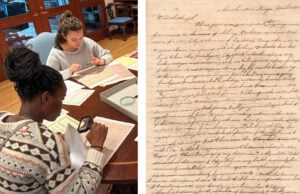
Last spring, the public included students visiting from Principia College in Elsah, Illinois, on their spring break. They saw artifacts from Mrs. Eddy’s youth and multiple editions of her writings. On house tours, they heard about key moments in her life and saw the rooms where she worked, slept, and ate. And during a session with Sarah, they pored over letters between members of the Baker family (magnifying glasses required to read that spidery 19th-century handwriting!).
Seeing the letters in person, rather than on a website, helped recent graduate Charles Gatobu pay attention to the details. “You could see that connection of a family that was together,” he says. “They loved each other.”
The experience “was definitely a great way to see the context and have a better understanding of what her life was like,” adds Ivan Vashchenko, a computer-science and mechanical-engineering major who was consequently inspired to do a summer independent study about Mrs. Eddy. “Just one week of learning this was not enough for me, so I really wanted to go deeper.”
This kind of feedback is deeply satisfying to the Collections team.
Underneath It All . . .
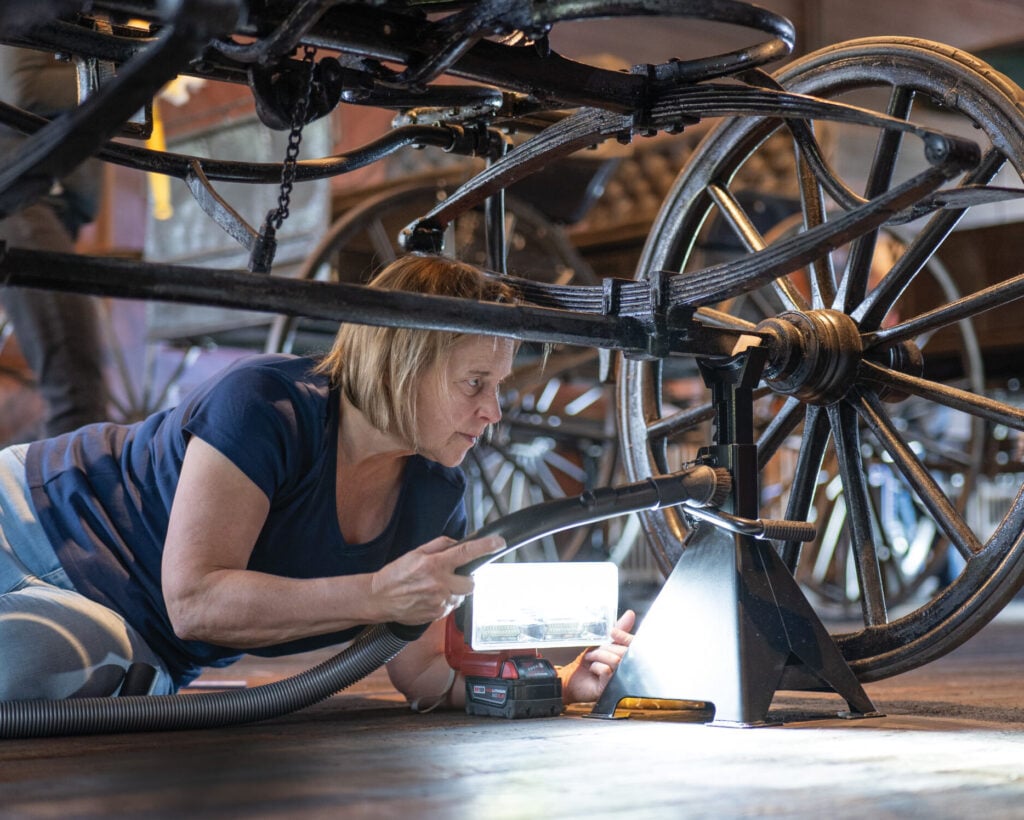
On any given day, it’s not always easy to guess what the Collections staff might be working on. They might be gathered around the long table in the Museum’s boardroom, discussing the best way to repair a torn page in an early copy of The Christian Science Journal. They might be lying on the floor vacuuming the underside of carriages in the 400 Beacon Street carriage house. Or they could be sitting together in the Museum’s basement workspace near the vaults for one of their “AHOD”—All Hands on Deck—sessions, carefully sorting fragile 19th-century letters, numbering them, and gently placing them in Mylar. They might even be peering into boxes of a recently donated collection, delighted to find four early editions of Science and Health with Key to the Scriptures that the Museum had not previously owned.
Whatever they are up to, Sarah says, they enjoy a warm sense of camaraderie, with each staff member bringing his or her “own distinct qualities to the project.”
And then she adds something else that they all share: joy.
“We’re working with Mrs. Eddy’s history, early workers, durable evidence about Mrs. Eddy. It’s just a joy to work in Collections,” she says. “We all understand the mission, and we gain a lot of personal enjoyment from our jobs. We like to share this enthusiasm and inspiration with others in whatever way we can.”
Stacy A. Teicher is Longyear’s senior research associate. Heather Vogel Frederick is the Museum’s research and publications consultant. Director of Communications Alice M. Hummer also contributed to this article.
 It Started With A Spinning Wheel
In the summer of 1910, Mary Beecher Longyear was invited to visit Mary Baker Eddy at her home in Chestnut Hill, Massachusetts. Mrs. Longyear had been a guest on other occasions, and this time she had just returned from Paris and arrived bearing gifts for the household, including flowers and a beautiful Oriental rug for Mrs. Eddy.
“The bright joyful face of Mrs. Eddy greeted me,” Mrs. Longyear later recalled. “She kissed me and welcomed me. … She asked me if I knew the reason she liked to have me visit her. When I answered in the negative, she said, ‘It is because you give me nothing to meet.’”5
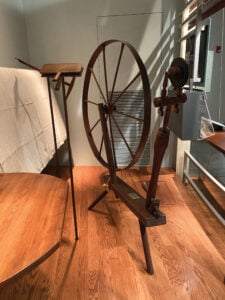
In addition to that high praise, Mrs. Eddy gave Mrs. Longyear a gift that day—an inscribed copy of her book Christ and Christmas. Interestingly, just a week later, the Christian Science Board of Directors offered Mrs. Longyear another gift: a spinning wheel that had belonged to Maryann Baker, Mrs. Eddy’s grandmother.
Mrs. Longyear’s reply to the Board has guided the Museum’s work ever since: “I hasten to assure you that I will accept the gift of the old spinning wheel with great joy. I fully appreciate the action and the evidence of trust the directors have in giving me this precious heirloom. I will guard it tenderly.”6
Those words, “I will guard it tenderly,” go straight to the heart of Longyear Museum’s mission. The staff as a whole, and the Collections Department in particular, has been charged with tenderly safeguarding and caring for the “precious heirlooms” that have been entrusted to Longyear to preserve for future generations.