The extensive restoration of 400 Beacon Street, Mary Baker Eddy’s final home, included the creation of an all-new visitor entrance and exhibit area. Here, visitors can learn about the life of the Discoverer, Founder, and Leader of Christian Science through a variety of panels and interactive displays. The Longyear team was very deliberate in incorporating child-friendly information and experiences. This article describes some of those, in the context of a larger story about the exhibit, “The Exhibit Space at 400 Beacon Street.”
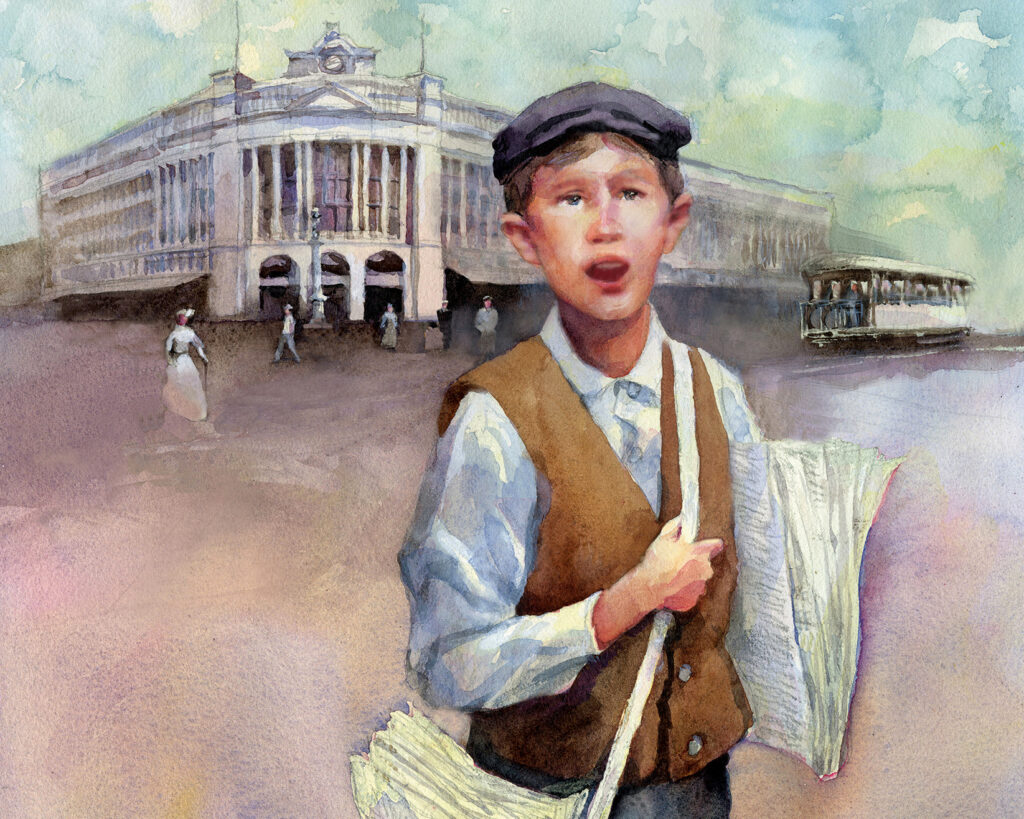
In 1910, a newsboy encountered a stranger waiting for a train in Boston’s South Station. The boy could see that the man was not well. “I guess you need The Christian Science Monitor,” he said, and offered him a copy. The man, who had despaired of recovering, found a religious article inside titled “Hope” and went to see a Christian Science practitioner. Within three weeks, he was healed. He returned to the station to thank the boy with $25. When Mary Baker Eddy heard the story, she asked to match the gift—if the boy could be found.1
If you are, say, six or seven and visiting the exhibit at 400 Beacon Street, you can read this story, but the learning experience doesn’t stop there. You can also see an artist’s rendering of the newsboy—complete with a sack of papers over his shoulder—and then lift a panel to reveal a full illustration of steam engines, train cars, women in long skirts, and men in suits and bowlers. Can you find that boy on the South Station platform? Look hard, he’s got $25 coming!
The story of the newsboy is just one way that the exhibit encourages all visitors—but especially younger ones—to touch, turn, pick up, push, listen … with the aim of engaging and immersing them in the story of Mary Baker Eddy’s life. “We really strove to reach a multigenerational range of visitors,” says design team member Stacy Teicher, a senior research associate at Longyear.
The exhibit team developed all kinds of activities for the younger set, and each of these is marked with a little acorn logo. The nut harks back to a favorite treat of Spike, the sociable squirrel befriended by Mrs. Eddy’s staff at 400 Beacon Street, who is featured in Longyear’s picture book, A Home for Spike, by Heather Vogel Frederick.
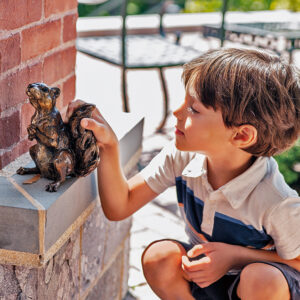 A small bronze sculpture of Spike with a collection of acorns greets children as they enter the vestibule leading to the exhibit. Once inside, they can follow acorn symbols for other enjoyable activities. For instance, who wouldn’t wonder how Mrs. Eddy moved her beloved equine friends down from New Hampshire to Chestnut Hill? A rolling drum with paper cutouts of horses inside answers that question.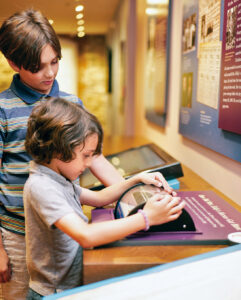
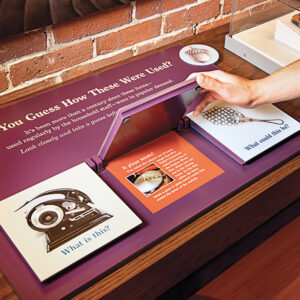 And it’s fun to try to guess what several unusual-looking early 1900s objects were used for in the home. A set of lift-up panels tests your knowledge. If you’d like to listen to the stories of some of the people who lived in the house, just pick up the earpiece of a vintage intercom telephone and hear from housekeeper Margaret Macdonald about Spike or John Salchow about making ice cream for Mrs. Eddy. (Learn more about “Faithful John” at this Longyear for Kids story.)
The hands-on experiences continue through the house tour, too—with objects in various rooms marked by the acorn logo (for example, a typewriter with a satisfying click-clack in secretary Adam Dickey’s room). Longyear’s intention is to continue finding creative ways to introduce, inform, and inspire young visitors with Mary Baker Eddy’s story.