Caring for a home is a constant demand, and maintaining historic buildings is no different. For Longyear Museum, 2026 was a year focused on significant projects at the Mary Baker Eddy Historic Houses in Concord, New Hampshire, and Lynn, Massachusetts. Thanks to the generous donations from museum members and friends, this work was made possible.
Winter-Proofing in Concord
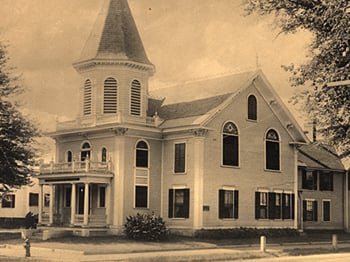
New England houses are subject to winter, which means that more maintenance is needed for these homes than houses in warmer climates. In early 2026, Rex Nelles, senior manager of historic houses, noticed a large icicle at the roofline during one of his routine house checks. Further investigation revealed an ice dam had split a gutter at its seam, causing water to leak into an eave and exterior wall of the house.
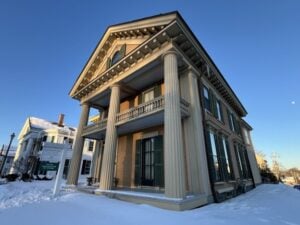
The Longyear team got straight to work removing the ice and repairing the eave. Then, thanks to the expertise of Doyle Construction, further mitigation was done to avoid ice dams in the future.
“Significant repairs are very infrequent,” says project manager John Alioto. He explains that whenever an issue arises, the team gets to the bottom of it to understand what happened and corrects the underlying issue to avoid problems in the future. To get a picture of what happened, you need to understand the structure of this historic house.
The gutters on the Concord house are made of copper, not your run-of-the-mill aluminum, and they are integrated into the slate roof so that they are invisible from the road, to preserve the look of the historic building. At the lower edge of the roof, the slate tiles come up against a sheet of copper (called the “wash”) which opens into a gully called the “integral gutter.” The gutter, essentially, is part of the roofline itself.
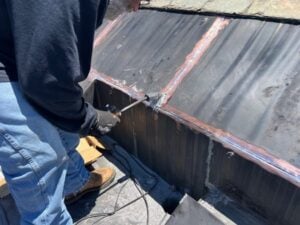
It’s not easy to replace an integral copper gutter. John points out that “you can’t buy a big piece of copper that’s in the shape of all this.” The Doyle Construction team determined that there were many decades of life left in the heavy-gauge copper, but all of the seams needed to be thoroughly cleaned and resoldered. This meticulous work was accomplished by a skilled craftsman using old-fashioned soldering irons. The team also noted that the standard best practice is to go only so many feet before needing an expansion joint. John describes the joint as folds of flat copper over the “mid-span” seam of the gutter, “like an accordion.” This helps keep the soldered seams from splitting open when the metal naturally expands and contracts due to temperature swings.
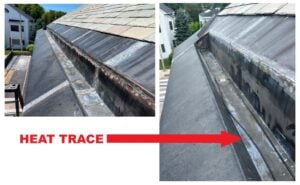
For further ice damn protection, Doyle Construction replaced the older heat trace system to keep ice from forming in the gutter. A “trace” is a thick wire that heats up and can be placed into a gutter to melt ice or snow. In this case, to make water flow away from the house, the heat trace fed through the downspout and partly into the earth. This way, water can be kept warm by the earth and dispersed into the dry well on the Concord property, which helps prevent erosion.
This wasn’t the only work that was done, however. Alexander Doyle told John, “You really should wire this copper wash, gutter, and downspout system to grounding rods in case you get a lightning strike.” A grounding rod differs from a lightning rod, which is fixed at the top of a roofline and is meant to attract lightning and shunt it to the ground through copper cables. John explains that the Concord house isn’t the highest point around, but that it was a good idea to ground the downspout system. “You don’t have to have a direct strike. Lightning can electrify an area and energize it,” John says, which could “go into the house and cause damage.” So, Longyear ensured the safety of the building by installing grounding rods. Now, “if there is ever lightning in the area,” John explains, instead of damaging the house, “it will run down into the earth.”
Reflecting on the project, John says: “We so appreciate working with Doyle Construction. They are a team of hardworking, honest professionals who are experienced in traditional historic roofing—in copper and slate.” The feelings appear to be mutual. Recently Alexander Doyle commented, “It’s a pleasure working on these buildings.” Now that everything in new construction is prefabricated, he says he enjoys looking at the craftsmanship of Longyear’s Victorian houses. Seeing something unique often prompts the comment, “Well, would you look at that? You don’t see that anymore.”
Historic Lynn House in Living Color
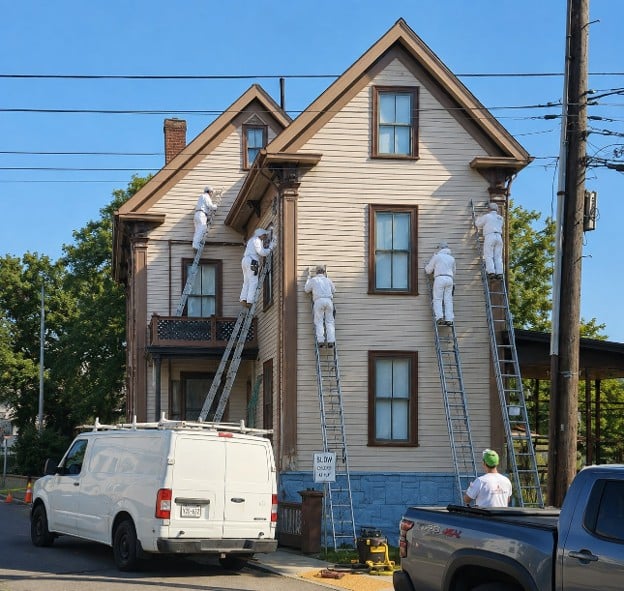
“To preserve the exterior of wooden houses, it’s best to paint them every seven to 10 years,” says Rex Nelles. “The goal is to protect the interior of the house from water penetration, pest infiltration, and keep the elements out. A sound roof, a good coat of paint, and solid foundation walls are key in keeping a house free from rot or deterioration.”
The Mary Baker Eddy Historic House in Lynn, Massachusetts, was last painted in 2011, as part of the complete restoration of the house after Longyear purchased it—so a fresh coat of paint was long overdue. However, before the house could be painted, some repairs were needed.
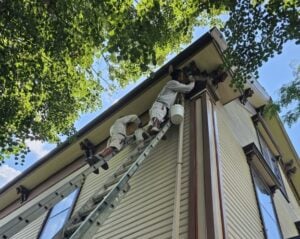
“If wood is properly cared for, it can last for hundreds of years,” says John Alioto, who also managed this project for Longyear. He points out that the Lynn house still has original wood siding and trim from 150 years ago, but “if wood gets wet and stays wet—or gets wet and dry and wet and dry—the more that happens, the shorter its life becomes.”
To understand what happened in Lynn, John says, “You have to pretend you’re a drop of water.” When there are driving rains or when the wind pushes water sideways, “it gets behind trim and behind the clapboard siding. And then it works its way down to the bottom.” In this case, the lower trim of the house had rotted at the corners. Longyear’s facilities staff Paul Paradis and Kevin Wingert spent several weeks replacing the rotted wood with a long-lasting lumber and sealed the end grain with epoxy to prevent water from wicking up. “We didn’t use ordinary boards,” John explains, “We used a special type of wood from New Zealand, Lifespan Select, which is clear of knots and pressure treated to the core with organic preservatives.” He points out that the organic preservative is ideal to avoid the arsenic in traditional pressure treated boards.
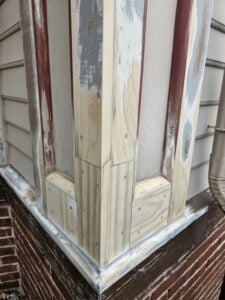
Once the Longyear team finished repairing the wood, it was time for painting. Paul Chalifour Painting had done exemplary work for the museum over the years, so Longyear was happy to bring in their expertise again.
Rex points out that one of the biggest challenges was maintaining the intricate color scheme of the house, which is typical of the Victorian era. Prior to Longyear’s 2010–2011 restoration, a paint analysis had revealed five unique colors during Mrs. Eddy’s time.
Not only were different colors used, but they were applied to different architectural elements—a “scrolled bracket,” for example, and a wooden “keystone,” similar to what you would see in a stone archway. “We made a book for the painters,” John Alioto says as he holds up a binder of 53 photos of the house taken from different angles—some of which were shot by a drone. Next to each element is a description of the color and sheen for each paint. The siding is “Renwick Beige;” some of the trim is “Fairfax Brown;” the shutters are “Black Forest Green,” he says as he points to the letter “S,” which is a code used to describe the satin sheen of the paint.
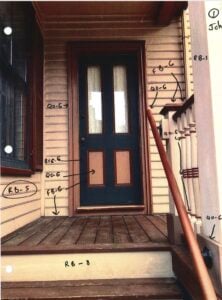
John copied these instructions for the multiple painters on the job so that they wouldn’t lose the color scheme. Rex estimated that Paul Chalifour’s team spent 700 man-hours painting the exterior.
“Seeing the fresh, brand-new paint makes the house stand out, and it looks so beautiful,” Rex says. He notes that “Mrs. Eddy kept a clean and tidy house, and the new paint gives a wonderful impression of her expectations to keep the house looking beautiful.”
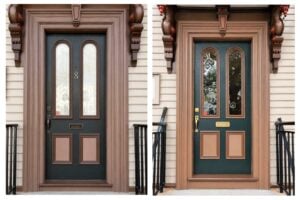
Left: Before painting Right: After painting
The Mary Baker Eddy Historic House in Lynn, Massachusetts holds a high significance for those in the Christian Science movement. “It’s the house with the skylight room. It’s the house where Mary Baker Eddy published the first three editions of Science and Health,” John Alioto says. He notes that it was also where the Discoverer of Christian Science formed her church and met and married her husband, Asa Gilbert Eddy. The house is also a National Historic Landmark, the highest designation for a historic structure in the United States.
John sees working at Longyear Museum as a privilege: “Mrs. Eddy cared for everything in her life … she also cared for her surroundings. And, if we love and respect her, we can care for her surroundings, her homes, and her belongings.” In the end, he says that maintaining these historic homes and putting them in good order is “a lovely opportunity to show that respect and care and appreciation for all that she did.”
Tessa Parmenter is Longyear’s senior writer and editor.