Music, both sacred and secular, kindled inspiration, enjoyment, and fellowship throughout Mary Baker Eddy’s lifetime. And while she was living at 400 Beacon Street in Chestnut Hill, Massachusetts, it was an almost daily feature.1 While many of the melodies she enjoyed singing (or having sung for her) were long-treasured hymns, she and members of her household also delighted in popular tunes played on one of the home’s three pianos, pianola (similar to a player piano), or other musical devices.
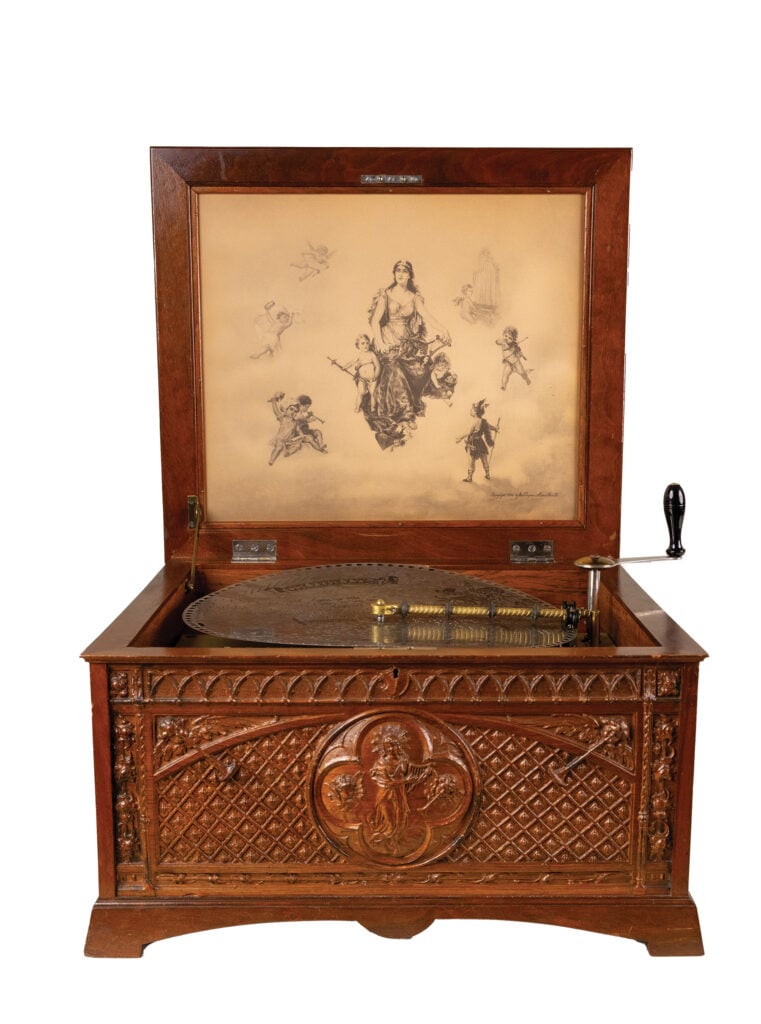
“Recorded” music did not exist in the late 1800s: It was either performed live or reproduced through a mechanical music box. In 1897, Mrs. Eddy’s student Laura Lathrop, and Laura’s son John—energetic and devoted workers in New York City—gave their Leader this intricately carved and illustrated Regina Music Box, which played both classical and contemporary music using perforated metal discs. It elicited her thanks for such a “kind, thoughtful, tender” gift.2 (Among the discs stored in the handsome oakwood cabinet was “Then You’ll Remember Me,” from a mid-1800s opera titled “The Bohemian Girl,” which Mrs. Eddy was partial to.)3
One Thanksgiving, after a convivial meal at Mrs. Eddy’s home in Concord, New Hampshire, a guest recalls that their host “asked that the new music box be started, in order that we might enjoy its sweet sounds.”4
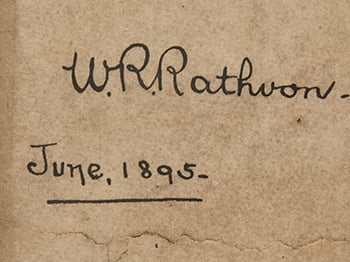
By the time of the January 1908 move to Chestnut Hill, Thomas Edison’s record-playing inventions were rapidly replacing mechanical music boxes.5 In fact, the household had been given a “Victor talking machine” by Mary Beecher Longyear a few years earlier. Both instruments made the journey, and the hand-cranked Regina was placed in the formal dining room at 400 Beacon Street, in the “special charge” of Calvin Frye. According to secretary William Rathvon, Mr. Frye would start up the box occasionally “for our delectation” during staff mealtimes, which were “often pleasant breaks in some serious and trying days.”6 Mr. Rathvon did note wryly, however, “I do not remember that an encore was ever requested.”7
From multiple reminiscences of Chestnut Hill and Pleasant View, these glimpses into the residents’ conversation and community, music and merriment, hint at the expansive view of home and hearth Mrs. Eddy treasured—that of the “home of Soul, where sense has no claims and soul is satisfied.”8
Mrs. Eddy’s collection of discs for the Regina music box included “William Tell Prayer” and “The Blue Bells of Scotland.” Click to listen.
Armin Sethna is Longyear’s former senior writer/editor.